
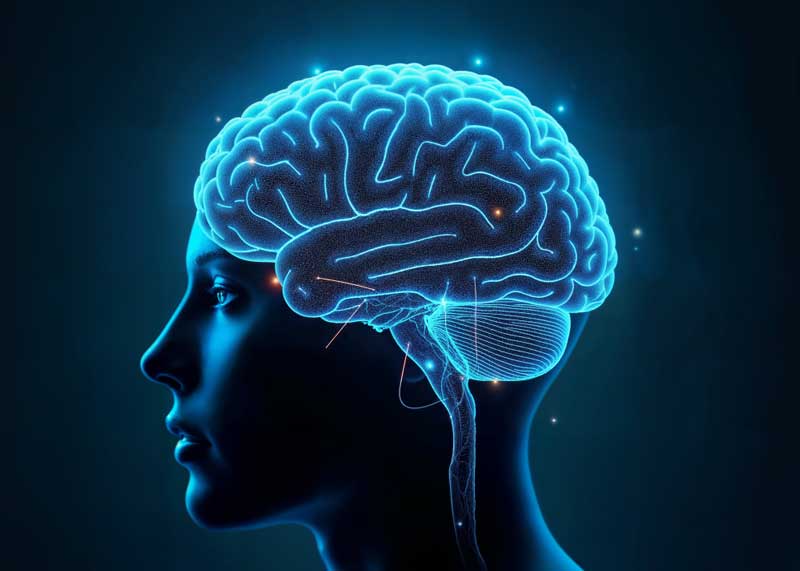
Why learning slows down: Scientists find the brain’s built-in ‘stop’ mechanism

The reason learning feels effortless at first—and then suddenly hits a wall—may lie in a little-known structure surrounding brain cells.

Researchers have identified a physical mechanism that appears to regulate not only how the brain learns, but also when it decides that enough learning has been done.

The key player is the extracellular matrix, a scaffold-like network surrounding brain cells. According to researchers, this structure is far more dynamic than scientists had previously assumed.

During the early stages of learning a new skill, the matrix temporarily loosens after practice, creating a window in which the brain can adapt. Within roughly a day, however, it rebuilds itself. As the skill becomes more familiar, this remodelling cycle gradually weakens—and eventually stops.

In effect, the brain appears to shift from ‘learn’ mode to ‘protect’ mode.

“For the first time, we’ve been able to see that the remodelling process changes as you gain experience,” said Melissa Caras, assistant professor of biology at the University of Maryland and senior author of the study published in Proceedings of the National Academy of Sciences.

The finding challenges the older view of the extracellular matrix as largely a rigid structure that restricts change, particularly in the adult brain. Instead, the researchers found that it can rapidly reorganise in response to training.

The team tracked these changes over much shorter intervals than earlier studies. Their observations showed a recurring pattern: the matrix loosens following practice, allowing learning to occur, and then rebuilds to stabilise what has been learned.

The researchers also tested what happens when the matrix is deliberately disrupted. Breaking it down impaired the ability to learn and master a skill. More disruption produced greater impairment. Conversely, disrupting the matrix even after a skill had been mastered caused performance to deteriorate.

The implication is striking: a learning plateau may not simply mean that the brain has run out of capacity. It may mean the brain has actively closed the window for further change in that particular circuit.

Caras suggested that the mechanism could eventually help explain familiar experiences such as plateaus in language learning. Brain regions involved in acquiring a skill may progressively move from a state primed for change to one designed to preserve existing learning.

The study is still at an early stage and does not offer an immediate treatment or learning hack for humans. But it adds a new dimension to the understanding of learning: the brain may not merely absorb information—it may also possess a biological system that decides when to open the door to change and when to shut it to protect what has already been learned.

Reference: Press Trust of India (PTI)

ET Healthworld

Bridge Lab and Market to Make Ayurveda Global, Says Jadhav

Young researchers and startups should play a leading role in transforming Ayurveda from laboratory research into commercially viable products, said Union AYUSH Minister Prataprao Jadhav, stressing that innovation must ultimately benefit society through affordable, evidence-based healthcare solutions. 

Addressing researchers, entrepreneurs and stakeholders at the 27th Meeting of the Governing Body of the Central Council for Research in Ayurvedic Sciences (CCRAS) in New Delhi, Jadhav said India possesses a rich repository of traditional medicinal knowledge, and its true potential can only be realised when scientific discoveries are translated into market-ready products. He called upon startups to bridge the gap between research institutions and industry by developing high-quality Ayurvedic formulations backed by modern scientific validation. 

He highlighted that the government was strengthening the innovation ecosystem through research support, startup incubation, quality certification and collaboration between academia, industry and regulatory agencies. He noted that robust scientific evidence, standardisation and clinical validation are essential for enhancing global confidence in Ayurvedic products and expanding their international footprint. 

Jadhav said India’s growing emphasis on evidence-based Ayurveda offers significant opportunities for entrepreneurs to develop new medicines, wellness products, digital health solutions and value-added herbal products. He added that commercialising laboratory innovations would not only improve public healthcare but also generate employment and strengthen India’s position as a global leader in traditional medicine. 

The minister also encouraged young innovators to utilise government-supported incubation centres, startup schemes and research programmes to convert promising ideas into scalable enterprises. He said closer cooperation among scientists, educational institutions and industry would accelerate the development of safe, effective and internationally competitive Ayurvedic products. 

Reiterating the government’s commitment to promoting innovation in the AYUSH sector, Jadhav said integrating scientific research with entrepreneurship would ensure that India’s traditional knowledge creates tangible health and economic benefits while reinforcing the country’s leadership in the global wellness market.

Reference

PIB, PTI, ET Health

Steps Afoot to Turn Kerala into Global Ayurveda Tourism Hub

Kerala’s long-standing reputation as an Ayurveda destination is getting a fresh policy push, with the Centre stepping up measures to promote Ayush-based medical and wellness tourism and position India as a global hub for traditional healthcare.

The Centre has introduced Ayush Visa for international visitors seeking treatment. It has partnered with India Tourism Development Corporation to promote Medical Value Travel in Ayurveda and other traditional systems.

Kerala figured prominently in the Centre’s Southern Zone Medical Value Travel Summit held in Chennai in May 2025, alongside Tamil Nadu, Karnataka, Andhra Pradesh, Telangana and Puducherry.

The State has a sizeable Ayush research network too. The work of two CCRAS institutions—the National Ayurveda Research Institute for Panchakarma at Cheruthuruthy, and the Regional Ayurveda Research Institute in Thiruvananthapuram—ranges from medicinal plants and traditional diets to clinical and botanical studies.

Kerala is home to research institutions in homoeopathy, Unani and Siddha as well. The National Homoeopathy Research Institute in Mental Health, Kottayam, currently has 34 research programmes, while the Siddha Regional Research Institute at Poojapura focuses on clinical research, drug standardisation and scientific validation of traditional formulations.

The Centre is supporting Kerala’s Ayush infrastructure through the National Ayush Mission, providing funds for medicines, manpower, equipment and the construction, renovation and upgrading of healthcare facilities. Two Centres of Excellence have also been approved in the State under the Ayurswasthya Yojana.

Quality and international accreditation are emerging as another key plank of the strategy. Kerala has 77 Ayush healthcare organisations accredited by NABH, while the Ayush Quality Mark Programme, launched in 2025, seeks to improve quality assurance and strengthen the international competitiveness of Ayush products and services.

The Centre is facilitating WHO certificates for eligible Ayush drugs and promoting Ayush Standard and Ayush Premium Marks through third-party assessment.

With Ayurveda and Yoga being taken up under international standardisation mechanisms, and Kerala constituting a State-level Ayurveda, Siddha and Unani standardisation committee, the State is increasingly positioned at the intersection of traditional healing, modern quality systems and medical tourism.

With its established Ayurveda ecosystem, research institutions and healthcare infrastructure, Kerala could emerge as one of India’s strongest gateways for global Ayurveda and wellness travel.

SANJEEVANI 2026 Roadshow in Kochi

As part of SANJEEVANI – Bharat Health Global Expo 2026, a special roadshow will be held on 13 August 2026 from 3 pm to 5 pm at IMA House, Kochi. The event is being organised in association with HOSPEX India. The roadshow aims to position India’s healthcare sector for global patients, international healthcare networks and overseas markets. 

The Kochi roadshow marks the South India leg of the international healthcare and wellness event scheduled for September 7 to 9, 2026, at Bharat Mandapam, Pragati Maidan, New Delhi. Organized by the Services Export Promotion Council (SEPC) under the Ministry of Commerce and Industry, it aims to promote India’s medical value travel, wellness industry, and traditional AYUSH systems.

   With Medical Value Travel gaining momentum, the session will focus on how hospitals, wellness centres, healthtech companies and MVT operators can explore Healthcare Services Exports from India. According to the organisers, the event will provide insights into global opportunities, international partnerships, and pathways to take India’s healthcare and wellness capabilities to the world.

Hospitals & healthcare providers, wellness centres, medical tourism/MVT operators, digital health & healthtech companies, and allied healthcare service providers can participate. 

Ayurveda and Health Tourism and Medical Tourism are media partners.

For details contact:

Mr. Benny Thomas – +91 9846121715 ;

Soumya TS – 90800 78447.

Language