
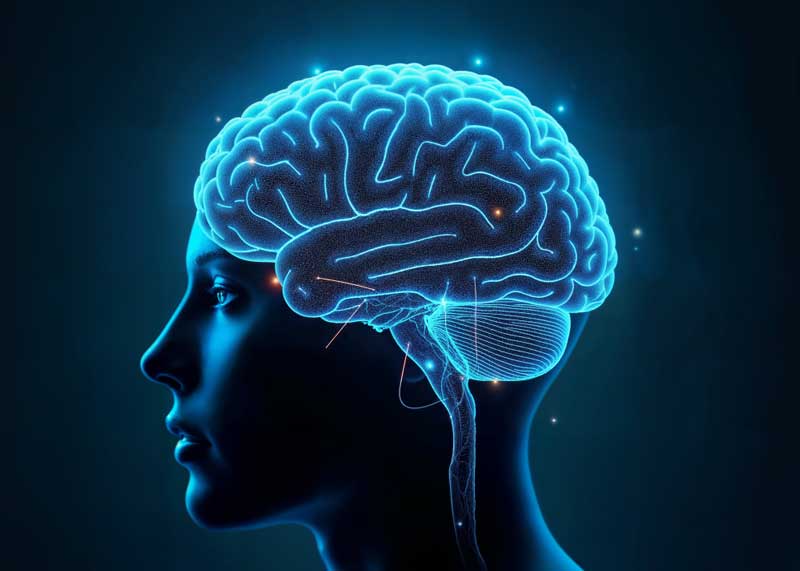
The reason learning feels effortless at first—and then suddenly hits a wall—may lie in a little-known structure surrounding brain cells.
Researchers have identified a physical mechanism that appears to regulate not only how the brain learns, but also when it decides that enough learning has been done.
The key player is the extracellular matrix, a scaffold-like network surrounding brain cells. According to researchers, this structure is far more dynamic than scientists had previously assumed.
During the early stages of learning a new skill, the matrix temporarily loosens after practice, creating a window in which the brain can adapt. Within roughly a day, however, it rebuilds itself. As the skill becomes more familiar, this remodelling cycle gradually weakens—and eventually stops.
In effect, the brain appears to shift from ‘learn’ mode to ‘protect’ mode.
“For the first time, we’ve been able to see that the remodelling process changes as you gain experience,” said Melissa Caras, assistant professor of biology at the University of Maryland and senior author of the study published in Proceedings of the National Academy of Sciences.
The finding challenges the older view of the extracellular matrix as largely a rigid structure that restricts change, particularly in the adult brain. Instead, the researchers found that it can rapidly reorganise in response to training.
The team tracked these changes over much shorter intervals than earlier studies. Their observations showed a recurring pattern: the matrix loosens following practice, allowing learning to occur, and then rebuilds to stabilise what has been learned.
The researchers also tested what happens when the matrix is deliberately disrupted. Breaking it down impaired the ability to learn and master a skill. More disruption produced greater impairment. Conversely, disrupting the matrix even after a skill had been mastered caused performance to deteriorate.
The implication is striking: a learning plateau may not simply mean that the brain has run out of capacity. It may mean the brain has actively closed the window for further change in that particular circuit.
Caras suggested that the mechanism could eventually help explain familiar experiences such as plateaus in language learning. Brain regions involved in acquiring a skill may progressively move from a state primed for change to one designed to preserve existing learning.
The study is still at an early stage and does not offer an immediate treatment or learning hack for humans. But it adds a new dimension to the understanding of learning: the brain may not merely absorb information—it may also possess a biological system that decides when to open the door to change and when to shut it to protect what has already been learned.
Reference: Press Trust of India (PTI)
ET Healthworld