

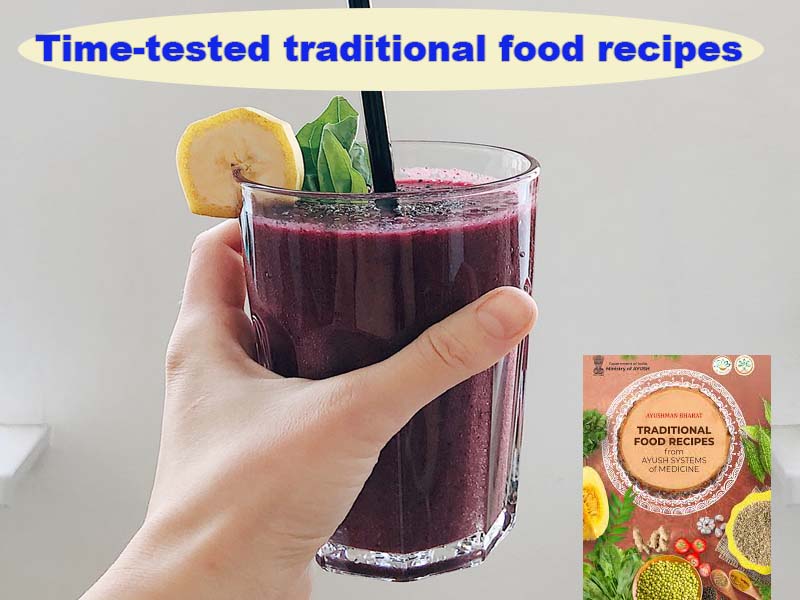
From Amalaki Panaka (Indian Gooseberry drink) to Mixed Millet Drumstick
Dosa, check out all the delicious traditional food recipes recommended by the
Indian AYUSH Ministry.
The ministry, which is associated with the government’s flagship programme ‘Poshan
Abhiyaan’ (National Nutrition Mission), has rolled out a booklet to create
awareness in the community about the tradition-based AYUSH food recipes.
Such dishes and food items “not only help in recovery from diseases but
also help in prevention of many illness conditions”, said Rajesh Kotecha,
Secretary, Ministry of AYUSH.
There is a lot of similarity between AYUSH dietetics and traditional foods in
India. The booklet consists of selected food recipes from AYUSH systems
including its ingredients, method of preparation, health benefits and
contraindications. The ingredients and cooking methods have been meticulously
chosen to obtain maximum benefits from locally available resources and food
practices.
The publication contains information on recipes and health benefits of 26
traditional food items including Amalaki Panaka (Indian Gooseberry
drink), khalam (medicated buttermilk), Yusha (medicated soup), Rasala
(medicated curd), Mamsa Rasam (medicated mutton soup), Peya
(medicated rice gruel), Ardraka Paka (ginger Barfi), Madhuka Leha
(herbal jam), Gulkand (rose petal jam), Apoopam (rice pancake), Patrode
(Colocasia Leaf Rolls) and Mixed Millet Drumstick Leaves Dosa.
Peya
The ingredients for preparing medicated rice gruel are Red rice (300 gm, water
(1500 ml)salt, mustard (1/2 teaspoon), cumin seeds (1 teaspoon), Fenugreek
seeds (1/4) tea spoon), Dry ginger (1/4 inch piece), cinnamon (1/4 inch piece),
cardamom (1), cloves (2) and coconut milk (100 ml).
Wash the rice and soak for five to 10 minutes, Roast the mustard, fenugreek and
cumin seeds and powder them coarsely, Boil water in a pressure cooker, add salt
and washed rice, add the powder, stir well and close the lid of the cooker.
Cook on medium flame till 4-5 whistles. Remove the lid when there is no more
steam and empty into a serving bowl. Serve hot with any stir-fried vegetables
and chutney.
Health benefits — Its low sugar and glycemic content and appreciable amount of
iron, zinc, manganese, calcium and fibre makes it a desirable dietary option
for heart patients, diabetics as well as for those with high blood pressure and
obesity. It is good for gut health and also helps in controlling the pulmonary
functions because of its rich magnesium, iron and medium chain fatty acids
content.
Ardraka Paka (Ginger Barfi)
The ingredients include ginger (250 gm), jaggery (250 gm), ghee (125 gm), dry
ginger powder (25 gm), cumin (25 gm), black pepper (25 gm), naagkesar
(25 gm), cardamom (25 gm), cinnamon (25 gm), Indian bay leaf (25 gm), long
pepper (25 gm), coriander powder (25 gm) and vidanga (25 gm).
Add jaggery into a heavy bottom pan and cook till a thick syrup is formed, Then
add ginger, stir and cook for 5-7 minutes on low flame. Add ghee and mix well,
cook for another 5-10 minutes. Now add the powder of all above ingredients and
cook for another 5-10 minutes and spread the content on a plate greased with
ghee. Sesame seeds may be added to make it bulky and augment health benefits.
Let it cool before cutting in pieces in any shape. When cooled, store in an airtight
container. It remains fresh for about a month.
Health benefits — The preparation helps in improving appetite and digestion.
Useful in prevention and management of sore throat, cold and cough.
Precaution — It may be taken only in appropriate quantities and never in an
empty stomach. Best to avoid in case of acid peptic disorders.
Gulkhand (Rose Petal Jam)
Ingredients are rose petals (250 gm) and sugar (250 gm). Collect fresh,
preferably desi rose petals, sort and wash well, dry thoroughly. May crush or
finely chop the petals. Mix the petals with sugar in an airtight jar. Keep the
jar in sunlight for 2-3 weeks. Stir well every day with a clean dry spoon.
Desired adult dose of gulkhand is 2 to 3 tablespoons, it may be blended
in milk to make a cooling drink.
Health benefits — Helps in digestion, improves health of gut flora and
intestinal mucus. Reduces hyperacidity and thus useful in peptic ulcers and
mouth ulcers. Pregnant women and kids can safely consume gulkhand to
relieve constipation. It helps in controlling various skin issues like pimples,
boils, blemishes etc. Provides restful sleep, increases urine output so can
help in reducing edema or patients having water retention due to various
reasons.
Contraindications — those with diabetes should strictly avoid.
Mixed Millet Drumstick leaves Dosa
The ingredients are pearl millet (bajra 30 gm), foxtail millet (kangni
30 gm), barnyard millet (sanwa 30 gm), sorghum (jowar 30 gm),
finger millet (ragi 30 gm), little millet (samai 30 gm), black
gram (60 gm), fenugreek seeds (10 gm), salt, drumstick leaves (30 gm).
Wash and soak all ingredients for 8 to 10 hours except salt and drumstick
leaves. Grind the ingredients and allow it to ferment for around 6 to 8 hours.
Spread the batter on a hot pan and sprinkle drumstick leaves over it. Apply
ghee, roast it and turn the dosa on the other side. Crispy delicious millet
dosa is ready.
Health benefits — Millets are a rich source of magnesium which helps to reduce
high blood pressure and the risk of heart attack, stroke, diabetes. Millets are
rich in fibre and good for weight loss. The leaf of drumstick is rich in
vitamin C, calcium, vitamin A, potassium and protein. Millet dosa is a perfect
food for celiac patients since it is completely gluten-free. Millets specifically
ragi and use of fenugreek seeds increase the production of breast milk in
feeding mothers.
Contraindications — People with thyroid problems need to restrict their
consumption of millets due to goitrogen, a substance that intervenes with the
production of thyroid hormones. Restrict the use in case of any discomfort such
as hyper acidity or bloating.
For more info, refer to the publication ‘Traditional Food Recipes from AYUSH
systems of Medicine’ rolled out by the AYUSH ministry.







