

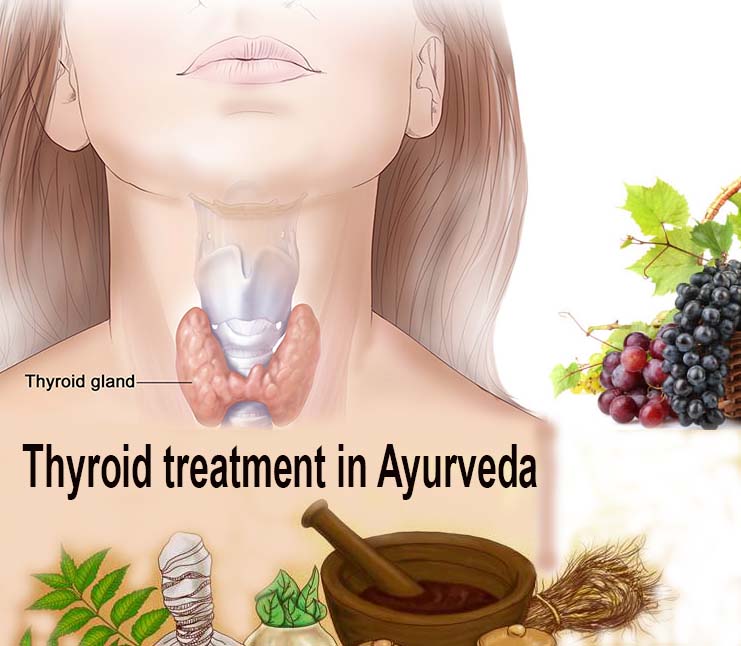
Ayurveda, the Indian holistic healing science,
has gained popularity all around the world. The American Thyroid Association
has recognized it as one of the common Complementary and Alternative Medicinal
(CAM) approaches to treat Thyroid disorder, a global epidemiological issue. Dr Nita Sharma Das, noted Ayurvedic practitioner and Naturopathy expert, explains how Ayurveda is beneficial in treating the disease;-
According to Ayurveda, our health depends on the
harmony of three humors (Tridoshas), i.e. air (Vata), fire (Pitta),
and water (Kapha). The imbalance of any of the doshas can cause
disorders. Patients suffering from symptoms of goiter specifically have Kapha-related
imbalance. Kapha particularly induces hypothyroidism and causes swelling
of neck (goiter). The imbalance of doshas is an underlying cause of
improper digestion, which leads to hypothyroidism. The Vata dosha is
particularly responsible for psychological stress which induces thyroid
disorder. However, only Pitta dosha imbalance can cause hyperthyroidism.
Therefore, Thyroid treatment is completely patient-centric as per the age-old
science.
Patients having clinical signs and symptoms of
Thyroid are assessed through various ayurvedic guidelines along with laboratory
test reports of thyroid-stimulating hormone (TSH), total triiodothyronine (T3),
and total thyroxine (T4). Ayurvedic practitioners prescribe treatment depending
upon the disease manifestation.
Evidential Ayurvedic formulations for Thyroid
disorder
Research studies have shown significant benefits
of Ayurvedic treatment in the following conditions:
•
Vata and Pitta-based Hashimoto’s thyroiditis with hypothyroidism
are effectively treated with grape decoction (Drakshadi Kashayam)
combined with external application of Ksheerabala on the thyroid. The
desired result can be usually obtained after six months of treatment.
•
Vata and Pitta-based hypothyroidism is effectively treated with
black fennel extract and external application of Ksheerabala on the
thyroid. The result can be obtained in a three-month treatment period.
•
Kapha-based hypothyroidism is effectively treated with Panchakarma
(primarily enema therapy).
•
Pitta-based hypothyroidism is treated with Kokilaksham Kashayam.
However, such patients usually have urinary tract infections also. Therefore,
patients also need treatment for urinary tract infection.
•
Pitta-based hyperthyroidism is effectively treated with Mahatiktakam
(ghee-based preparation) and external application of Ksheerabala on the
thyroid.
Sida cordifolia
is the primary herbal ingredient in Ksheerabala preparation. A herbal
decoction is prepared first and then sufficient sesame oil is added to it. The
mixture is then boiled with milk. Repeated boiling is required by adding a
definite amount of milk to prepare a concentrated mixture. After 101 days of
following the same process, the final product is ready for clinical use.
Triphaladya Guggulu and Punarnavadi Kashaya are two Ayurvedic
formulations prepared with different herbal ingredients that are useful in
treating thyroid disorders. A human trial concluded that these two formulations
are effective in managing hypothyroidism.
•
The rhizome of Shunthi (ginger), the fruit of Pippali (Long
pepper), the fruit of Maricha (Black Pepper), the fruit of Amalaki
(amla), the fruit of Haritaki (Harad), the fruit of Bibhitaki
(Beleric), the bark of Kanchnara (Mountain Ebony), the resin of Guggulu
(Mukul myrrh tree) and Madhu (honey) are mixed to formulate Triphaladya
Guggulu.
•
The root of Punarnava (Red Hogweed), the stem of Devdaru
(Deodar), the rhizome of Shunthi (ginger), and resin of Guggulu
(Mukul myrrh tree) are used to formulate Punarnavadi Kashaya.
Apart from these, Ashwagandha is also an
effective herbal remedy to balance thyroid gland functioning. The improvement
in thyroid gland functioning results in effective management of hypothyroidism.
The intake of Ashwagandha herbal formulation maintains serum T3 and T4
levels.
Diet and Lifestyle measures
Ayurvedic treatment also considers diet and
lifestyle management to treat any chronic condition.
•
A vegan diet for thyroid patients is effective to manage body weight and BMI
under control.
•
Daily intake of sufficient amounts of iodine-rich products maintain thyroid
functioning. But sudden shifting from low iodine intake to high iodine intake
increases the risk of autoimmune thyroid disease.
•
Selenium and vitamin B12 containing food helps to manage autoimmune
thyroiditis.
•
Excessive intake of isoflavones, acacia, and gluten hamper thyroid functioning.
•
Lacto-Ovo vegetarian diet including eggs and dairy products is effective in
preventing iodine deficiency-related thyroid disorder.







