

Ayurveda,
the ancient Indian medical science, should be strengthened through
evidence-based research, standardisation and documentation to facilitate its
global acceptance, according to experts.
“There is no question over the efficacy of holistic healing science. But
you need to prove each Ayurvedic formulation if the global community needs to
accept them. Establishing matrix effect of the marker constituents of decoction
and the like should be taken up without fail. The safety and standardisation of
ayurvedic drugs should be laid down to make them commercially viable and to
enhance Ayurveda reach,” pointed out Sreeraj Gopi,a chemist who has done
extensive research on Phytochemicals (plant-derived chemicals). He is a Fellow
of the Royal Society of Chemistry.
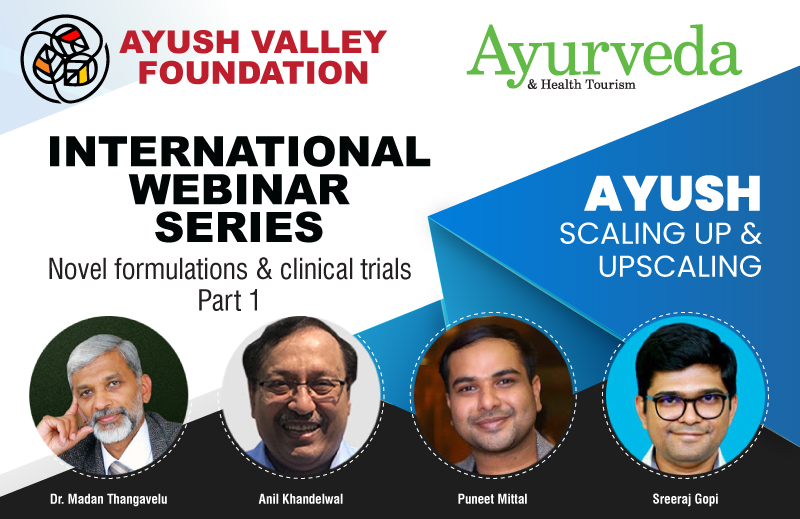
He was speaking in the international webinar on ‘AYUSH: Scaling Up &
Upscaling — Novel formulations and Clinical Trials’, organised by the Ayush
Valley Foundation in association with the Ayurveda & Health Tourism
Magazine.
Anil Khandelwal, Managing Director, Yogicsecret Healthcare Pvt Ltd, stressed
the need to focus on natural products as therapeutic agents rather than going
for disease-specific approach.
“80 per
cent of non-communicable diseases are on account of lifestyle habits. The
treatment should be on root-cause of these diseases — inflammatory conditions,
and the focus should be on preventing them,” he said, while batting for
preventive healthcare.
Puneet
Mittal, Director, Clinical Research, Mittal Global Clinical Trial Services,
explained in detail the various processes for clinical trials of Ayurveda
formulations and how shortcomings in current practices can be rectified.
“The
usefulness, safety and adverse effects, all need to be laid down clearly. The
Ayurvedic formulations should be statistically validated and justified for
worldwide acceptability of Ayurveda,” he said.
Meanwhile,
the meaningful discussions threw up challenges like the cost of research and
the waste of valuable time in “proving time-tested treatment procedures”.
“Reverse
pharmacology is more needed for Ayurvedic trials. The foundations have already
been laid down and clinical practices should build on that. We need a
patient-oriented approach rather than an industry-oriented one,” said
noted Integrative Oncologist Dr Arvind Kulkarni.
“There
is no need to prove the system… a large section already knows the value of
the ayurvedic treatments based on their personal experience. Instead there’s a
need for awareness,” said Dr Bhaswati Bhattacharya, a practicing holistic
family physician-scientist.
The over
two-hour session was moderated by Dr Madan Thangavelu, noted Genome Biologist
from the University of Cambridge, UK.







