
Panchakarma has become a familiar term for most
of us today. It’s a critical component of Ayurvedic treatment. The statement ‘Ayurveda
is not a treatment but a way of life’ is perhaps ubiquitous today. It essentially
means that Ayurveda aims to maintain normality of health in people in addition
to curing diseases.
The concept of Ayurveda is based on the Tridosha theory. According to this concept, the physical,
physiological and psychological aspects of individuals are attributed to their tridoshas, or the three humors – Vata, Pitta and Kapha. A balance of tridoshas
leads to normalcy in health, and a loss of it gradually results in
manifestation of diseases. Many factors like diet, habits, exercise, emotional
factors, seasonal variations and age may be responsible for this vitiation. To
put in a nutshell, treatment in Ayurveda is about bringing the tridoshas back to normalcy.
When thinking of doshas
and their balance, a question may arise as to how we bring all diseases under a
single roof of dosha vitiation. How
can we include conditions like infections that result from external causes?
Well, Ayurveda classifies diseases into Nija
(caused due to factors within the body) and Aganthu
(caused due to external factors). In
case of Nija, vitiation of dosha occurs prior to the disease, whereas
in Aganthu, the causative factor
precedes vitiation of doshas. Thus deviation from normalcy of doshas occurs in both cases.
Hence treatment in Ayurveda consists of several steps, which
include identification of causes of the disease and their prevention (nidana parivarjana), expulsion of the
vitiated dosha from the body (sodhana chikitsa), alleviation of the doshas that are vitiated (samana chikitsa) and finally
rejuvenation of the body to its original state (rasayana chikitsa). Among this, samana
chikitsa and sodhana chikitsa are
major treatments. Samana chikitsa is
relatively simple and can be done on an outpatient basis. Dosha balance can be restored by the gentle procedures of samana if the perturbation is mild. Sodhana chikitsa/ panchakarma is a more
complex procedure, and it expels the vitiated doshas from the body. In more simple terms, Panchakarma flushes out the toxins and uproots the disease
completely, and is done especially when the perturbation of doshas is severe.
Concept of personalised medicine in Ayurveda
The normalcy of doshas
in an individual is considered as prakriti
of that particular individual. Prakriti
can be somewhat regarded as the Ayurvedic way of determining the genetic
constitution of an individual in terms of three doshas.
Genomic studies of recent times have proved that people with similar
prakriti have identical genetic
make-up. Though the prakriti is
grouped broadly into seven, depending upon the predominance of one or two or
three doshas (one type), innumerable
permutations and combinations are possible between them. It is similar to each
human having a unique genetic combination, where two persons can be genetically
similar but not exactly alike.
Disease is considered as a deviation from prakriti. Since the normalcy of doshas is unique for each individual, their
deviation from normalcy is also unique and consequently so is the required
treatment for the individual. This is essentially why we call Ayurveda a personalised
medicine.
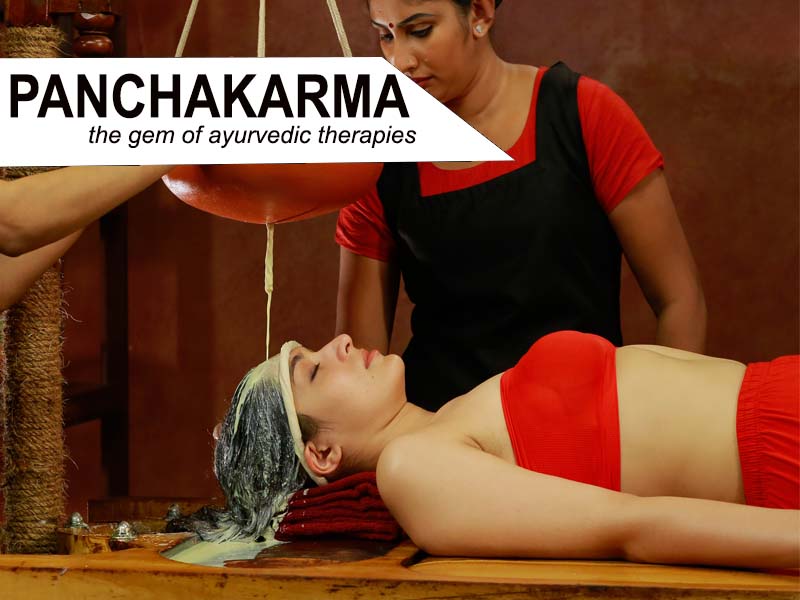
Panchakarma
The term Panchakarma
means five processes. The five karmas
include Nasya (instillation of nasal
medication), Vamana (emesis/ vomiting),
Virechana (purgation), Snehavasthi (oil enema) and Kashyayavasthi (decoction enema). Raktamoksha (bloodletting) is also an
important process in the surgical point view of Ayurveda, even though it is not
included under Panchakarma.
A Panchakarma treatment
can be divided into three phases:-
n Purva karma/
preceding phase /preparatory phase. This phase includes Snehapana (oil/ghee intake) and Sweda
karma (sudation therapies).
n Pradhana Karma/main
phase of Panchakarma treatment –
includes the five processes mentioned above.
n Paschaat Karma/
succeeding phase/Follow up – mainly includes dietary patterns
Purva karma/preparatory phase
Snehapana (oil/ghee intake)
Snehapana can be prepared in two ways. One
method is to have oil/ghee daily in small doses (Vicharana snehapana) along with normal food. The second method is
to have oil/ghee in increasing dose on empty stomach for 3-7 days (Accha Snehapana). The second method can
be done only when the person is completely under doctor’s direct supervision
since there are increased chances of complications. The type of Snehapana, the dosage, type of oil/ ghee/animal
fat and the number of days, all depend upon the patient’s strength and disease
condition and should be determined by the doctor.
Snehapana is arguably the most difficult form
of treatment for the patient as well as the doctor, especially when performed
in high doses. The oil or ghee consumed as part of this procedure spreads all
over the body, and in the last days of Snehapana,
one can smell the ghee in the hair, skin and bed of the patient and also feel
the oil in their skin and hair follicles.
Svedana Karmas (sudation therapies)
Svedana Karmas are done in conjunction with
external oil application. It’s normally done after internal administration and along
with external application of oil. It includes almost all types of massages.
These processes are often done under the label of Panchakarma whereas in reality it’s only a preparatory therapy of Panchakarma. Svedana
Karma can be done in various techniques like oil application and steaming;
application of bolus made of medicated powders, leaves, rice etc. The required
technique is selected based on the condition of the patient. This phase of treatment
is usually pleasurable for the patient, but many restrictions are required for
a successful therapy. Generally, it’s done for seven days. The procedure can be
continued till the certain symptoms of saturation or optimum application (samyak lakshanas) appear in the patient.
More than one Svedhana karma can be
done in a patient.
The oil intake/snehapana
and sudation therapies/Sweda Karmas
can also be done as Samana Chikitsa.
In such cases, it’s not associated with Panchakarmas.
However, for doing Panchkarmas, oil
intake and sudation therapies are mandatory. The five purification procedures
on their own can’t remove vitiated doshas
present in the vast network of body channels. Hence the purvakarmas help to loosen and mobilize the doshas from the body channels, clear the openings of the channels
into the alimentary canal and deliver them into its lumen.
Five Pradhan karmas/
Main processes
Vamana/ Emesis
The Vamana
process is done to eliminate the vitiated kapha
dosha from the body. Specific emetic drugs are selected as per the
condition of the patient and repeated emesis is induced for the complete elimination
of doshas.
Virechana/Purgation
Virechana is done to eliminate the vitiated Pitta dosha from the body. The purgative
drug and its dose are determined by the condition of the patient.
Vasthi/ Enema
Vasthi is of two types – Kashaya Vasthi (non-lubricant) and Sneha vasthi (lubricant enema). It is
done to eliminate the vitiated Vata dosha.
Decoction enema/ Kashaya Vasthi plays
a major role in elimination of doshas,
but it can be done only in combination with oil enema. Otherwise it may give
rise to complications. The number of days and medication for Vasthi is determined by the condition of
the patient. Vasthi alone is regarded
as half treatment in many conditions.
Nasya (nasal instillation of medicine)
Nasya includes the instillation of nasal medication
and is done for the elimination of doshas,
mainly in diseases affecting head and neck region. The Purvakarmas like snehapana
and generalised swedana is not mandatory
for nasya. But application of oil and
fermentation is done in the head and neck region. The purvakarmas like Snehapana
and generalised swedana is not mandatory
for nasya. But application of oil and
fermentation is done in the head and neck region just before the procedure.
Rakta Moksha
Rakta Moksha is also an important process of Sodhana, but is not included under the
title of Panchakarma. This process
includes the removal of impure blood from different sites of the body through
scarification using metallic instruments and application of leeches. The site
depends upon the disease condition. This treatment is seen to be effective in
cases where other treatment procedures fail to yield results.
Panchakarma — Follow up treatments
During this phase, the body will be in a very fragile condition.
The digestive capacity will be weak and to
protect and enhance the same, certain dietary patterns and restrictions (pathya kala) are advised for this period.
In practice, it’s normal to take upto three months before receiving the
benefits of Panchakarma even though
changes start to occur just after the treatment. This period doesn’t require
hospitalisation.
(Authors Dr Divya P and Dr Ramesh G are Consultants of
Agasthya Parva Ayurveda)