

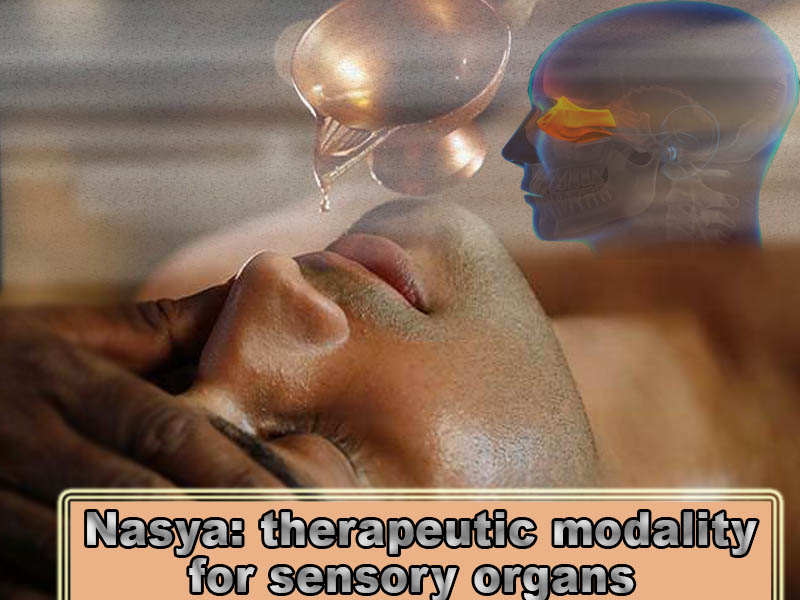
Ayurveda, the holistic science of life, emphasizes on periodical
bio-cleansing of the body to eliminate vitiated doshas. Nasya is one of
the techniques of bio-cleansing (panchakarma)
and is the unique therapeutic modality among the procedures for diseases affecting
organs of the head (urdhwajathru vikaras).
Nasayam Bhavet nasyam: ‘Administration of medicines through nasal route is called ‘nasya’.
Nasa hi siraso dwaram
tat vyapya thena hanthi tan’: ‘Nose is the gateway to the organs of the head and the
effect of the medicine will spread to the vital organs and cure the diseases’.
Ayurveda suggests the medications administered via nose reach
Sringataka marma. (Marmas are physiologically vital points
in the body). It is the marma in the
head (siramarma) formed by the union
of blood vessels supplying blood to the nose, ear, eye and the tongue. Thus,
the drug administered through nasya
may enter the above blood vessels and purifies them. Hence the term sirovirechana (cleaning of the head) is
also used to denote the process.
According to the anatomical description, nasal passage is the
part where the cranial nerves, especially the olfactory receptors, are more
exposed to the cribriform plate of the ethmoid bone. Besides, the nasal passage
leads to paranasal sinuses and its mucosal epithelium is very sensitive to
various stimuli. The absorption of the drug effect through the nasal mucosa
will be rapid and the quantity of drug required to produce the desired result
will be less. Moreover, the enzymatic inactivation that usually affects during
the oral route administration can be avoided in this method of drug delivery system.
Since the nerves located at the nose have connection with
hypothalamic-pituitary-pineal glands, the medication through the nasal rout will
have its impact on the brain, too.
Nasya classification
Nasya is classified differently by various
Acharyas. Charaka mentions about Navana, Avapidana, Dhoomapana, and Pratimarsa while Vagbhata classified it
into Samana, Brumhana and Virechana.
Samana Nasya: It is a palliative nasya that cures the disease without eliminating
the vitiated doshas. This is good
mainly in conditions such as skin discoloration, hair loss and eye diseases.
Decoctions of medicinal herbs and milk can be used for this purpose.
Bruhana Nasya: It is a rejuvenation type nasya and is indicated mainly to nourish
and strengthen the organs in head, especially sense organs, and intellectual functions.
It is also indicated in Vata
predominant diseases of the head like migraine, loss of voice, diseases of the
mouth, difficulty in opening yes, difficulty in lifting hand etc.
Virechana Nasya: It is elimination type nasya that expels the doshas from the head. Majority of Teekshana Nasya comes under this
category.
Another category of Snehana
nasya is marsa and prathimarsa based on the dose and
strength of administration.
Marsa Nasya is the method of application of sneha (medicated ghee/oil) in its full
dose of six to 10 drops. Its clinical implication is also very high.
Pratimarsa nasya can be performed on any person and
is aimed at rejuvenating the sensory organs.
Nasya is also classified based on the
parts of the medicinal herb used. They are the ones using phala (fruits), puspa (flowers),
kanda, niryasa, patra (leaf), moola (root) and twak (bark).
Another classification is based on pharmaceutical
preparation. They are churna (powder), Kshra (ash), madya (essence), sneha
(oil), kalka, kwatha, mamsa (meat) and
dhuma (fomentation).
Tailamevacha nasyardhe
nityabhyasena shasyate
Sirasa; sleshmadhamatvat
sneha swasthasya netare
‘Taila (medicated
oil) is the best option for regular nasya
practice in healthy individual, as head is the seat of Kapha.
Mode of action
The medicinal properties of the drug used in the form of nasya stimulate the vital centre in the
brain and related structures. The nourishing properties of the drug rejuvenate
the tissues. The medicines eliminate the vitiated doshas, remove congestion in blood vessels and clear the channels (sritas). The overall effect of nasya is correcting the neurovascular
anomalies.
Restrictions
Nasya is not performed on people suffering
from diseases such as chronic sinusitis, respiratory disorders, infective
condition of the head, indigestion, coughs and acute fever.
Practical indication of nasya
The nasya with specific
medicinal preparations are used mainly in clinical conditions like cervical
spondylosis, frozen shoulder, hemiplegia, facial palsy, seizure disorders,
mental disorders, head ache and ENT condition.
(By Dr P K S Nair,
National Research Institute for Panchakarma, Cheruthuruthy, Thrissur.)







