

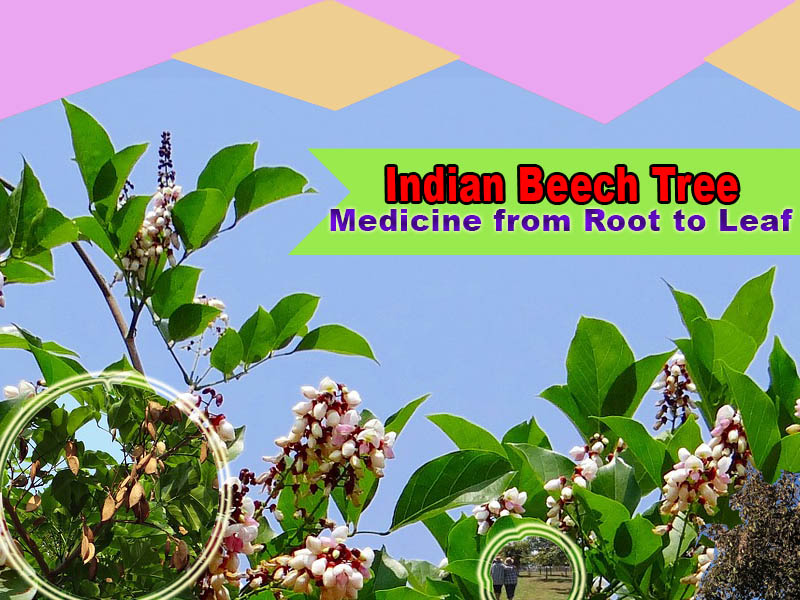
A tree often planted on road sides for shades, the Indian beech tree possesses medicinal
properties, may it be its leaves, roots, bark, fruit, seeds and flowers. There
are only a few other trees like this which Ayurveda depends on in its fight
against diseases.
The Indian beech is medicine from root to leaf. It is an
essential ingredient in several formulations to treat a variety of diseases
such as psoriasis, gastro diseases, rheumatism and blood disorders. They are
even used as tooth brush.
The medicinal tree finds mention in both Charaka Samhita and Susrutha
Samhita, the Ayurveda classics. While the former classifies it as
antipruritic, the latter describes it as an effective drug used against worms,
skin diseases, diabetes and problems related to the head. No wonder the use and
reference to the Indian beech dates back to the Vedic period with the Rig Veda and Adharva Veda having references about the magic tree.
The medium-sized tree – which grows to a height of 18 meters
and 1.5 meters in girth – grows easily in any tropical climate and is generally
seen near hilly areas, mainly near water resources. It sheds leaves once or
twice a year, after which new golden yellow leaves cover the tree like a crown.
Fragrant, lilac or white-tinged with pink or violet flowers appear in the axils
of the leaves in May-June. Fruits are pod-disc shaped with a single seed
inside.
Chemical constituents
The seed contains 27 per cent bitter-tasting volatile oil
which contains chemical constituents such as karanmjin, pongamin and glabrin.
These are useful in formulations to treat skin diseases. Pongapin, isolongocarpin and
ovalitnone are some of the other constituents. The bark of Indian beech
tree has bitter alkaloids and chemicals which act against skin diseases.
Medicinal effects
From its root to its bark, leaves, seed and oil, every part
of Indian beech has a therapeutic quality. Based on its pharmacological properties,
Indian beech guards the body against many diseases– eczema, scabies, leprosy, ulcers,
tumours, piles, and enlargement of spleen, vaginal and urinary discharges.
Formulation: Used in paste form or as juices,
decoction and oil.
Treatments:
Skin diseases: Applying its seeds in paste form is
very effective in treating skin ulcers. In case of chronic skin ulcers, paste
of the leaves is used. It’s effective against allergic skin diseases like urticarial.
The seed oil is used in cutaneous affections, herpes and scabies. Juice of its
roots is also used to treat infected wounds. The decoction obtained by mixing leaves
of the Indian beech, root of chithraka
and saindhava with buttermilk is also
good for skin issues.
Orthopaedic conditions: Medicated oil prepared with Indian
beech seeds are used to treat orthopaedic conditions known as Mamabhighata. Medicated coconut oil along
with the bar of the Indian beech tree is used to heal external injuries like
sprain and fractures.
Arthritis: Apply seed oil. Take a bath in water boiled with Indian beech leaf.
Digestive disorders: Take Indian beech leaves in the form
of juice, salad or chutney.
Blood purification: Decoctions and alcoholic
preparations called arishtas and asavas containing Indian beech help
purify blood.
Fistula: Juice of the root is used for closing
fistulous sores and cleaning foul ulcers.
Diabetes: Its flowers are used in many
formulations to treat diabetes.
Cough: The powder of the seeds is used in
medicines for whooping and irritating coughs of children.
Modern studies have proved that the leaves of Pongamia pinnata possess marked antinociceptie as well as antipyretic activities and thus scientifically
validated its use in the treatment of pain and pyretic disorders.
In earlier times, Indian beach sticks were used as toothbrush
as it satisfies the three tastes ideal for cleaning teeth – pungent, bitter and
astringent.
Method of Cultivation
Indian beech is as non-fussy tree and grows in any tropical
climate/ region. It requires no particular care, but only sufficient sunlight.
Seeds and twigs are used for reproduction. An Indian beech in your backyard
will give you relief from diseases apart from shades that protect you from the scorching
sunlight.
Latin Name: Pongamia pinnata
Family: FABACEA
Names in other languages
Hindi : Dithouri
English: Indian Beech
Malayalam: Ungu
(The author S Sreelakshmi is an Ayurveda Doctor presently
practising abroad. She can be contacted at ssrelakshmi@gmail.com)







