

Now that the Covid-19 pandemic has
begun to show signs of retreat, the possibility of recruiting agencies in the
public, private and cooperative sectors conducting competitive examinations has
brightened. In India, there is going to be a flurry of examinations—the Civil
Service Examination, Banking Service Recruitment Board examinations, State
Public Service Commission examinations, etc.—as the reopening happens. It is
literally going to be a challenge for each candidate, as each of these
examinations test not just the cognitive skills, but also the brain’s power of
retention of information gathered over the past two years and more.
Nutritive food and proper exercise do
play an important part in the development and retention of memory, but these
need to be backed up with external supplements and stimuli. Ayurveda has a
treasure trove to offer here, both in terms of knowledge about ways to
stimulate the brain and in terms the herbal backup that each individual can
depend on to improve his/her memory.
Ayurvedic Concept
of Intelligence
Memory is one among the most
impressive and wonderful aspects of the human brain. By definition, memory is
the ability of the body to retain information and recall them after short or
long periods of time. However, Ayurveda considers memory not only as a simple
retention of information. It sees memory as a ‘flower’ blooming from attention,
concentration, intelligence, and quality of life.
According to Ayurveda, intelligence is
a combination of three capabilities of the mind: (a) Acquisition and analysis
of information, (b) Retention of the acquired information, and (c) Recollection
of the acquired information. But these capabilities of the mind do not stay in
the same state of readiness at all time. Memory can get impaired over time due
to various reasons.
Ageing is an easily understood reason
here. So are diseases such as Alzheimer’s and Parkinsonism. And also, accidents
that damages the brain. But there are others that affect people’s power of
recollection during their active life. Stress arising from modern lifestyle,
for instance, is one of the most important among them. That is where Ayurveda
comes in. And some of the remedies to memory impairment that Ayurveda offers
can be done at home.
We can improve our memory considerably
by using certain herbs which contain specific molecules known as ‘nootopics’.
Researchers have found that a molecule acting as ‘nootopic’ can increase the
level of Acetylcholine, the neurotransmitter in the brain, improve oxygen
supply to the brain and ensure supply of more neuro-chemicals (such as certain
enzymes and hormones) to the brain.
In Ayurveda, the herbs that promote
memory and intelligence are called ‘medhya oushadis’. In India, several medhya-herbs
are traditionally in use which are non-toxic and without side effects as
compared to compounds that perform the same function. Chinese traditional
medicine also has its own herbs for enhancing a person’s cognitive power. They
all work on different mechanisms but here we mention only those herbs which are
mentioned as brain-boosters in Ayurveda.
One point to remember is, all these
herbs form part of specific drug formulations such as Chyavanaprasam,
Saraswatharishtam, etc., which one should take only after consulting an
Ayurvedic physician.
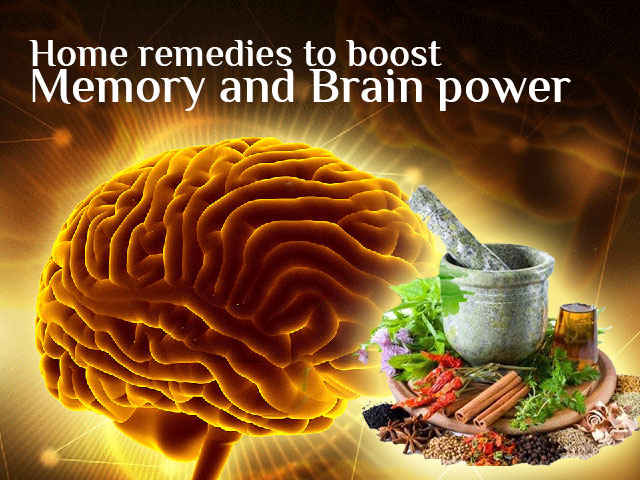
Here are a few of the home remedies to
boost memory:
Kudangal Juice
with Honey
Kudangal or Muthil (Centella
asiatica), known in Sanskrit as Mandukparni is a very common plant in Kerala.
It is well known for its brain-boosting activities, which has earned it the
name: ‘Sthalabrahmi’. It has been proved to be very effective in enhancing
blood circulation in the brain which, in turn, can improve concentration, making
the brain more receptive to information retention.
Use of this composition has given positive
results even from mentally retarded children. Kudangal-leaf juice ground with
gooseberry can be mixed with honey when it has to be given children. The whole
plant also can be pressed to get the juice, which can be served with butter. It
is better to use this medicine in early the early morning.
Gooseberry Juice
The Indian Gooseberry (Emblica
officinalis), popular by the name Nellikkai, is also well known for its power
to increase memory-power. It has been scientifically proved to have a direct
effect on the amount of functional Acetylcholine, the neurotransmitter in the
brain. It can effectively reverse drug-induced memory deficits and is now being
used in the management of Alzheimer’s disease. Thriphalachoornam, Chyavanaprasam,
etc., contains the fruit of gooseberry which, in its fresh state, is a rich
source of Vitamin C, Vitamin B Complex, Calcium, Iron, Albumin and Cellulose.
The fruits can be taken as fresh juice or along with milk.
Brahmi Juice with
Honey
Brahmi (Bacopa monnieri) is
traditionally used as learning and memory-enhancer and as herbal cure for lack
of concentration, anxiety disorder etc. It is a constituent of Saraswatharishtam
and Brahmikhrutham, Manasamithram Gulika, Mahamanchishtadhi Kashayam etc. Brahmi
is a well-known ‘nootopic’ due to the presence of bioactive constituents like brahmine,
steroidal saponins which experimentally proved to be memory-enhancers. Those
who worry about frequent lapses in memory can take Brahmi (ground and sun-dried
in shade) along with cow-milk. It is better to use it with fresh milk and in
empty stomach. Fresh Brahmi-juice also can be used in the same way. In case of
children, it can be mixed with butter or honey in empty stomach.
Vayambu with
Brahmi
Known as Vacha in Hindi Vayambu (Sweet
Flag: Acorus calamus) is herb you can’t avoid if you are musician (vocalist) or
a student. It can improve your concentration and enhance your power of
acquiring information. Known in Sanskrit as Ugragandha, the medicinally
useful parts of the plant include the scented leaves and rhizomes which can
also have a neuro-protective effect. Traditionally Vayambu is dried and then
powdered. It is mixed with Brahmi and taken internally. If available, more
ingredients such as Kudangal (Centella), Mustard, Naruneedikkizhang (Root of
Hemidesmus indicus), Kottam (Indian Costus), Thippali (long Pepper) and Rock
Salt can be added.
Amukkuram Powder
in Milk
The roots of the plant, known in
Sanskrit as Ashwagandha (Withania somnifera) due to its smell of horse,
is one among the most remarkable memory-booster in Ayurveda and it has earned
the nickname as ‘Indian Ginseng’. As per modern research, it can even reverse
memory-loss caused by Electro-Convulsive Shock Therapy. Well-known in Malayalam
as Amukkuram, it can improve the brain, nerves, function of the heart and it is
well known for its power to improve sexual power in men. Its powder (purchased
as such or made) can be taken with milk or ghee. It can be given to children as
well as old aged people.
Shankhpushpum
with Thulsi
If you are lethargic during daytime
and has anxiety and stress, but is getting only little sleep at night, all you
need is a cup of ‘tea’ made up of Shankapushpam (Convolvulus pluricaulis) and
Tulsi. It is the most popular psycho-stimulant and tranquiliser used in Indian
traditional medicine. The plant as a whole contains β-sitosterol, vitamin C or
ascorbic acid, vitamin E and various other compounds. One teaspoonful powder of
this can be taken twice daily along with a cup of milk. The ‘tea’ can also be
made using one cup of water to which three flowers of Shankapushpam and six
leaves of Tulsi can be added, boiled and taken hot.
Irattimadhuram-Mix
Liquorice is actually the name applied
to the root extract of the plant known in Malayalam as Irattimadhuram
(Glycyrrhiza gabra). It is known in Ayurveda as ‘Medhyadravya‘ due to
its therapeutic usage as a brain tonic and brain re-vitalizer. The liquorice has
been shown to boost the learning skills in mice and so scientists believe that
its strong neuro-protective effect can make it a potent medicine for
Alzheimer’s disease.
Powder half-a-pound each of Irattimadhuram-root,
dried Ginger (Chukku), Cumin seeds, Cardamom and dry-fried paddy grain (Malar).
Mix 5 grams of this powder with cow-ghee and take it internally for good
effect.
Literature Cited:
Halder, S., et al., (2021) Herbal drugs and
natural bioactive products as potential therapeutics: A review on
pro-cognitives and brain boosters perspectives, Saudi Pharmaceutical Journal
(doi:https://doi.org/10.1016/j.jsps.2021.07.003)