
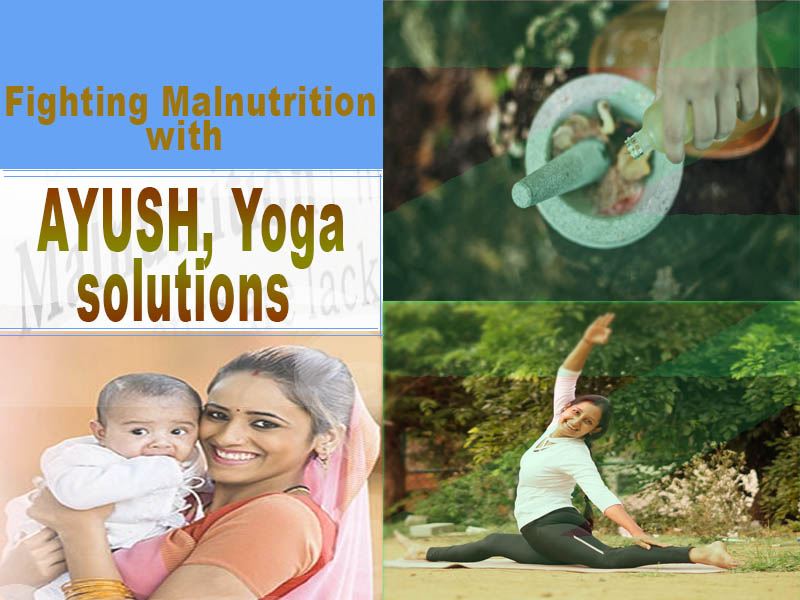
The Indian government is all set to adopt time-tested and
scientifically proven Ayush-based solutions and Yoga practices to tackle the
problem of malnutrition in mothers and children.
A Memorandum of Understanding was signed between the Ministry
of AYUSH and the Ministry of Women and Child Development to address the
malnutrition challenge as part of the POSHAN
Abhiyaa (National Nutrition Mission) programme.
“Nutri-gardens and medicinal gardens will be established in
every Anganwadi in near future,” said Smriti Irani, Minister for WCD.
Shripad Yesso Naik, Minister of AYUSH, said Ayurveda and
other AYUSH systems have much to contribute in dealing with mild and moderate
mal-nutrition by way of specific measures such as right intake of diet by pregnant
women, feeding practices by lactating mothers, use of traditional products
augmenting milk secretion, nutritional food for children etc.
Vaidya Rajesh Kotecha, Secretary, Ministry of AYUSH and Ram
Mohan Mishra, Secretary, Ministry of Women and Child Development, signed the
MOU at a function held in New Delhi on Sunday.
As per the agreement, the Ministry of AYUSH and Ministry of
WCD would be working together towards integrating Ayush in POSHAN Abhiyaan and management of malnutrition through the
principles and practices of Ayurveda, Yoga and other Ayush systems.
POSHAN Abhiyaan or National Nutrition Mission is
Government of India’s flagship programme under the Ministry of Women &
Child Development to improve nutritional outcomes for children, pregnant women
and lactating mothers.
The specific areas identified for co-operation include: (i)
Integration of AYUSH into POSHAN Abhiyaan
and (ii) Control of malnutrition through the principles and practices of
Ayurveda, Yoga and other Ayush systems.
1) At Anganwadi Centres
A. Yoga
programmes
B. Visit of
AYUSH workforce to Anganwadi Centre once in a month followed by sensitization
meeting of AYUSH medical officers with Anganwadi workers in coordination with
State health Authorities (Department of WCD)
C. Development
of PoshanVatika.
2) For AYUSH Nutritional Care
A. Generation of
baseline data in nutritional status of targeted population
B. Provision of
Telemedicine/ AYUSH helpline / call centres through Common Service Centres
C. Customization
of region specific nutrition
D. Proper
documentation of all efforts for scientific evaluation
3. IEC
activities to develop awareness among the community about the traditional
indigenous food items and promote the concept of nutrition based on Ayurveda
and other AYUSH systems
4. The Anganwadi
worker who is providing the Ayurveda nutrition message to the community at
ground level may be designated as ‘DHATRI’ – Dedicated Health Activist to
Replenish the Innutrition.
5. Other such
activities for promotion of Ayurveda and other AYUSH systems and providing
holistic nutritional care through integrated approach.