

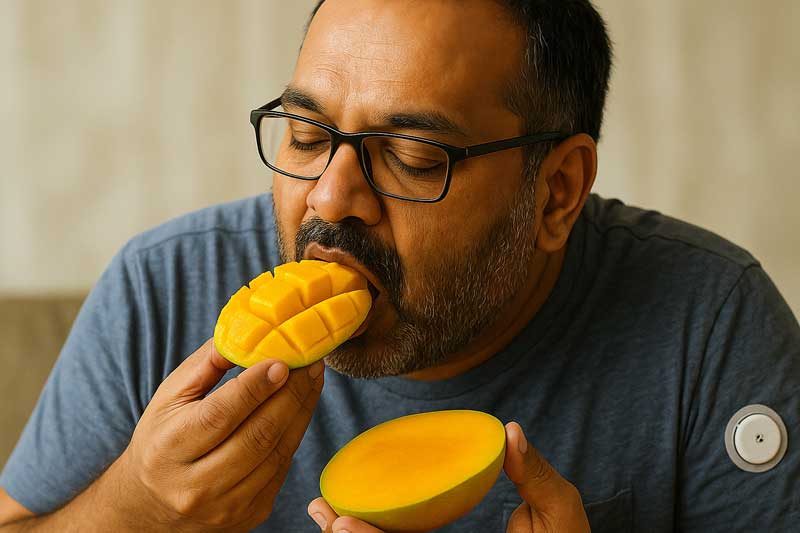
People with diabetes find it hard to resist a ripe mango though doctors generally advise them to keep away from the sweet fruit as it can cause a rapid spike in the blood sugar level. But the results of a new study will help cheer them as the fruit can be a good substitute for refined carbohydrates like bread.
The study by the researchers from Fortis C-DOC Hospital for Diabetes and Allied Sciences and the National Diabetes, Obesity and Cholesterol Foundation (N-DOC), New Delhi, reveals that in restricted amounts and as a replacement for refined carbohydrates like bread, mango can blunt blood sugar spikes in people with Type 2 diabetes,
They studied the effects of three Indian mango varieties — Safeda, Dasheri and Langda. The randomized controlled trial involved 35 adults with Type 2 diabetes who consumed either 250 grams/day (one small mango) or an equivalent amount of white bread at breakfast for eight weeks.
The findings were striking. Mango consumption reduced fasting blood glucose by 26.9 mg/dL with Safeda and 36.1 mg/dL with Dasheri. HbA1c, a marker of long-term glucose control, dropped by 0.9 percentage points with Safeda and 0.5 points with Dasheri, compared to bread. Mango also improved insulin resistance, reduced body weight (2–2.4 kg), lowered waist circumference, and increased good cholesterol levels.
The study, led by Dr. Sugandha Kehar and co-authored by Dr. Anoop Misra, showed that mangoes (glycaemic index 51) produced a lower blood sugar response than bread (glycaemic index 70–75). Importantly, mango must replace refined carbs, not be eaten as an add-on.
Dr. Kehar cautioned that mango will raise blood sugar if eaten as dessert after a heavy meal. Instead, it should be consumed in portion-controlled amounts (not more than 250 g) at breakfast or as a mid-meal snack, ideally paired with protein such as toned milk or curd.
“Mangoes are loved but maligned for their sugar-raising effect. Our study shows that within prescribed diets, they are not detrimental — and may even be beneficial,” said Dr. Kehar.







