

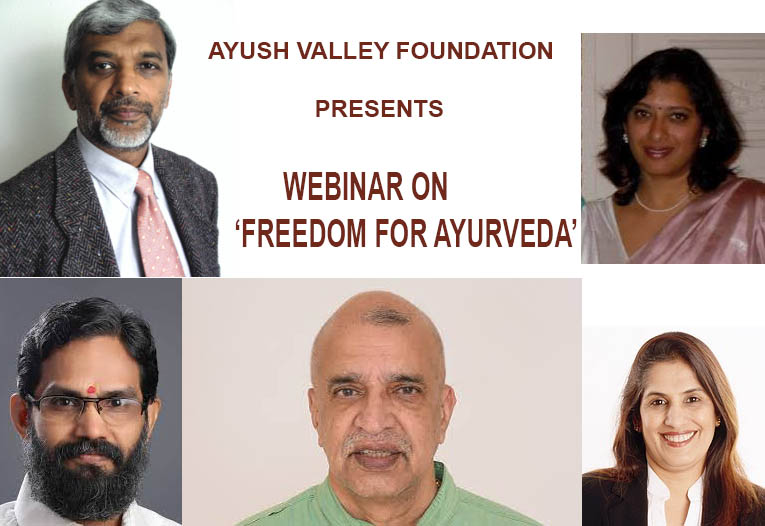
Experts have called for strategic interventions
including policy formulation and better budgetary resource utilisation in key
areas like Health services, Education and Research to facilitate the growth of
Ayurveda and its elevation into the mainstream medical practice.
“…growth of the Ayurvedic sector is happening
for sure. But, currently, a great deal of commodification is taking place. It’s
not growing in the way it should …the challenge is to effect strategic
interventions,” said Padma Shri Anant Darshan Shankar, Vice Chancellor,
Transdisciplinary University, Bengaluru.
“For instance, in Education, the Minimum Standard
Requirements is holding back the sector. We need to create Centres of
Excellence which should be extended autonomy and the freedom to experiment new
models,” he said in a free-wheeling conversation as one of the Speakers of the
Webinar held on the topic ‘Freedom For Ayurveda’.
The event was the third of the international
webinar series being organised by the Ayush Valley Foundation in tie up with
the Ayurveda & Health Tourism Magazine. The interactive session was
moderated by Dr Madan Thangavelu, noted Genome Biologist from the University of
Cambridge, UK, and Dr Bhaswati Bhattacharya, a renowned Physician-turned
Ayurvedic practitioner.
Another Speaker Vaidya M Prasad,former Principal of
Ashtamgam Ayurveda Vidyapeedham, Palakkad, Kerala, too stressed on the need for
reformations.
“There is a need for complete overhauling of the
curriculum. It should not be mixed with notions of Modern Medicine and leave
the students a confused lot…. Similarly, the so-called researches involving
Ayurveda are actually leveraging the traditional medicinal system for the
growth of the western medicine. This is clear as such exercises, including that
for a Covid-19 cure, are done without invoking Ayurvedic thought process,” he
said.
Asmita Wele, Head of Rasashastra and
Bhaishajyakalpana Vigyan, College of Ayurveda, Bharati Vidyapeeth University,
Pune, though batted for integration of the sciences, saying the best practices
should be combined.
“There is no question about a patient-centered
treatment approach. But the cross reference is always possible. We should try
to bridge the gap between the sciences …and work in teams. The best practices
should be combined and applied at every level,” she said.







