

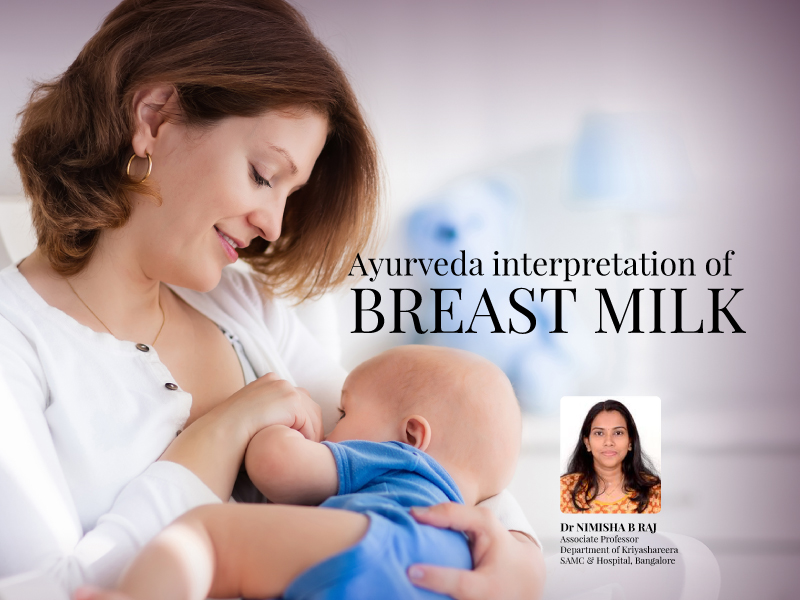
Breast milk is the most valuable food for the newborn and in early childhood.
Breast feeding is of utmost importance for the healthy growth of the child. It
also helps in the postnatal contraction of the uterus in the mother. It is
produced to suit the digestive capacity and nourishment of the new born child
and a natural process. The knowledge regarding breast milk is unique in
Ayurveda. Vagbhada has quoted the importance of stanya and stanyapana as
follows.
मातुरेवपिबेत्स्तन्यंतत्हिअलंदेहपुष्टये।(A.H U 1/14)
A well-studied narration of
the physiology of Stanya is seen in every classical text book
of Ayurveda. The milk secretion coming from stana after prasava is
called as stanya. In the physiological level, stanya could
be dealt in following sections.
· Physiology of stanya formation (Stanyanirmana)
· Physiology of milk ejection (Stanyapravrittihethu)
· Qualities of ideal breast milk (Stanyasampat)
PHYSIOLOGY
OF STANYA FORMATION
Stanya is
the upadhathu of rasa dhathu. Ayurvedic classics
unanimously claim that the effective establishment of lactation occurs only
after three days of parturition. When rasadhathu is subjected
to transformation in prasoothavastha in a female, its sara portion
formed in breast region is known as stanya. This physiology
can be experienced since conception.
After digestion of food the rasa is
formed. Sweet essence part of this rasa circulating through
the entire body by the action of vyanavayu reaches breasts and
is termed as stanya. Kasyapa is of the opinion
that the ahara rasa of a pregnant woman nourishes three things
– one part to nourish the mother’s body, one part to nourish the garbha,
and the third part to form the stana and stanya.
PHYSIOLOGY OF MILK EJECTION
The milk is ejected from
the breast by thought, touch, sight and physical contact of the body with the
child. Maintenance of lactation is mainly by the uninterrupted affection
towards the baby.
As per the modern
physiology, mainly two hormones are determining the effective lactation.
· Prolactin: From anterior pituitary for milk
production
· Oxytocin: From posterior pituitary for milk
ejection (Let down reflex)
Of these, prolactin is a
purely somatic component, whereas oxytocin is chiefly functioning according to
the emotional status of the subject.
The hormonal and neural mechanism involved in lactation is complex. With the
delivery of the placenta, there is an abrupt and profound decrease in the
levels of estrogen and progesterone in the blood which somehow serves to
stimulate lactation. Now, the prolactin is free to exert its action on breasts
and to promote lacto genesis. In normal circumstances, the intensity and
duration of lactation are controlled to a larger extent by the repetitive
stimulus of nursing. The neuro-hypophysis secretes oxytocin in a pulsatile
fashion which stimulates the expression of milk from a lactating breast by
causing contraction of the myoepithelial cells in thealveoli and small milk
ducts. The ejection or letting down of milk is a reflex initiated by suckling
which in turn stimulates the neuro-hypophysis to liberate oxytocin. Many
psychogenic factors or even generalized sympathetic nervous system stimulation
throughout the mother’s body can inhibit oxytocin secretion and consequently
depress milk ejection. It may be inhibited by fight or stress.
As per Ayurveda, after
delivery, only on the third or fourth day the dhamanis or siras situated
in cardiac regions get dilated and initiate milk ejection. The first three days
of deficient lactation in a female after delivery is due to the lack of
efficient opening of sthanyavaheesiras which are attached
to hrdaya.
So,the physical properties of ideal milk can be
listed as,
· Volume – 2 anjali
· Colour – Sankhaavabhaasam
· Taste – Madhura, kasayaanurasa
· Smell – Madhugandhi
· Guna – Laghu
· Veerya – Seeta
· Vipaka – Madhura
· Karma – Vatapittasamana
· Plain water test –
Formation of homogeneous mixture







