

“Tat cha nityam prayunjeet svasthyam yen
anuvartate.
Ajaatanam vikaranam anuttpattikaram cha yat.”
(One should stick to a diet that provides basic
nutrition to the body and helps one keep it healthy. Such a diet can prevent
the incidence of diseases: Charaka Samhita: Sutra Sthana: 5).
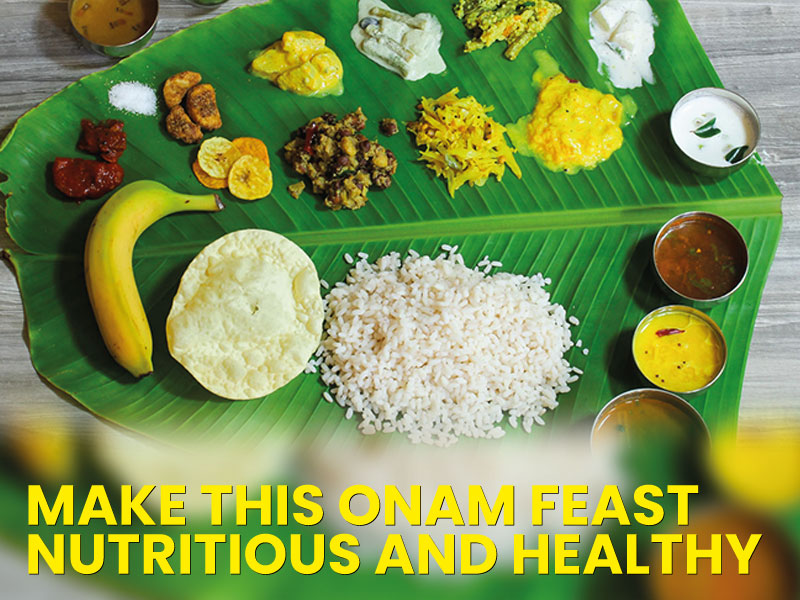
The Onam feast, which Malayalis call Onasadhya,
is the high point of Onam festivities, something that lingers on one’s
tastebuds years after that luminous experience of a colourful Onam.
Onam is incomplete without the feast
and therefore the saying ‘Kaanam vittum Oanam unnanam’, which literally
translates to ‘Must have the Onam feast even if it means pawning off the last
asset’.
Onam feast is a ritual from start to
finish, from the moment the first vegetable is cut to the moment when the
sweetness of ‘paayasam’ (Hindi: Kheer; Punjabi: Phirni), takes it to a
sweet crescendo.
Preparation of the feast itself a
festive affair, all the members of the family joining hands to prepare the
dishes. Onasadhya is a sumptuous spread consisting mostly of traditional
Kerala vegetarian dishes, each bringing with it a taste of its own and
contributing to the nutritional value of the feast as whole.
Ayurveda recognises such food items
as nutraceuticals which are variously classified such as Rasayana (food
that can avert the degenerative changes caused by ageing) and Jeevaniya
(maintaining the joie-de-vivre).
The concept of nutraceuticals as
advocated by Charaka categorizes all food items into twelve classes: corns with
bristles, pulses or legumes, meat, leafy vegetables, fruit, vegetables which
are to be consumed raw, wines, water from different sources, milk and milk
products, products of sugarcane, oils and salts, and other subcategories of
these major classes. It is interesting to note that even the daily consumption
of specific food products has certain specifications mentioned under Aajasrika,
which can offer protection from internal and external stress factors.
The usage of nutraceuticals is determined
based on the age of the person, season of consumption and physiological
conditions of the body. Ayurveda states that health of a person is dependent on
Vata, Pitta and Kapha, the predominance and levels of which determine the
Prakruti (physical characteristics) of a person.
Onasadhya, its preparation and ingredients used depicts the close links that
existed between the people of Kerala and the local flora. Even common people
were well aware of the nutritional value of the indigenous plants.
Let’s take a look at the nutritional value of
certain traditional dishes served as part of Onasadhya.
Parippu
Parippu represent the main ‘starter’
of the Onam-feast. It is also customary to pour ghee over this. Parippu is to
be served over the ‘steaming rice! That also is a traditional practice. Parippu
or Dal, as it is known in North India is believed to be brought to Kerala along
with the arrival of the Aryans.
For preparing Parippu curry, split
form of Green Gram (Cherupayar) is heated in an alloy vessel and then cooked
with enough water mixed with turmeric powder and salt. Press thoroughly to make
it a paste while still in flame. To this, Coconut well ground with Cumin seeds
and Garlic are added. This can be mixed with Coconut oil seasoned with Curry
leaves.
Nutritional
Value: Green Gram is a very rich in
protein and it contains reasonable amount of Iron. Studies have found that
Iron-deficiency is very common where people are not using Green Gram (CAB
International, 1989).
Inchikkari
Inchikkari, otherwise known as Injippuli or
Puliyinji is more or less like a pickle and it has its origin in Tamil Nadu.
The role of Inchikkari is “to make a way to the feast” which is basically an
appetizer made with a mix of Ginger (Inchi) and jaggery cooked in groundnut
oil. It can also be made as a combination of curd and Ginger which is a local
variation of the same.
Nutritional Value: Ginger contains Zinc, Manganese, Copper,
Calcium, Iron, Sodium,
Phosphorus and Potassium. The high sodium and
potassium ratio found in Ginger has a role in reducing high blood
pressure. However, Ginger is low in
Calcium which is very much needed for the integrity of bones. The level of Manganese, Zinc and Copper is moderately lower in Ginger and so there
need not be a fear for
toxicity due to these minerals.
Aviyal
Aviyal represents a ‘thick mix’ of
almost all the vegetables. Banana (Nenthran variety), Yam (Chena), Pulses
(Payar), Snake Gourd (Padavalanga), Cucumber (Vellarikka), Drumstick
(Muringakka), Carrot, and Green Chillies (Pachamulak) are normally used. The
vegetables are cut in finger size and cooked along with grated coconut and
groundnut oil, seasoned with the curry leaves.
Nutritional
Value: Among fruits, banana is valued for
potassium content, because of its role in maintaining blood pressure. Potassium content is highest in Nendran (546.66 mg/100g). And it is low in Sodium which is beneficial
in the prevention of high blood pressure. Yam is composed mainly of starch,
with some proteins, lipids, vitamins, minerals and a wel -balanced amino acid
content. Drumstick leaves and fruit are the richest source of β-carotene and so
it can be a good source of vitamin A.
Olan
Olan is a true-Kerala dish, the main
ingredient of which is Wax Gourd (Kumbalanga). It is cut into square pieces and
cooked along with Red Cowpeas (Vanpayar), which is to be put in water one day
in advance, to get it soaked. The Cowpea is cut into small pieces along with
green chillies and cooked with the White Gourd pieces. This can be then mixed
with coconut oil seasoned with the curry leaves. In certain places of Kerala, coconut
milk is also mixed with this.
Nutritional
Value: Potassium and Calcium present in
Wax Gourd play a beneficial role in maintaining electrolytic balance of body. It
can be alkalinizing the body also. Though Red Cowpea is a rich source of
Ascorbic Acid (Vitamin-C), β-carotene, Iron and Calcium prolonged cooking or pressure
cooking can result in significant loss of them.
Kaalan
Kaalan is another true-Kerala dish,
which forms part of the Onam-feast. The main ingredients of Kaalan are Yam
(Chena), Banana (Nenthran variety) and curd. Curd mixed with water and Turmeric
powder is heat-dried with green chillies. When it is dried enough coconut
ground well with Cumin seeds is added. This is to be mixed with Coconut oil
seasoned with Mustard seeds, Fenugreek seeds, and dried Red Chillies. Curry
leaves and Fenugreek seed-powder is added and stirred. This is to be kept in
flame and then removed after adding salt.
Nutritional
Value: The beneficial aspects of Yam and
Nenthran are already mentioned. Cumin seed is found to exhibit promising
activity against Shigella infection. The extract of seeds is reported to
exhibit anti-ulcer activity by decreasing the volume of acid in gastric juice.
Erissery
Erissery also is a true-Kerala dish,
the main ingredient of which is Pumkin (Mathanga). The next main constituent is
Red Cowpeas (Vanpayar) which is to be thoroughly pre-cooked and used. Pumkin is
cut into pieces and cooked to which ground Coconut mixed with Cumin seeds and
Garlic are added. This can be mixed with Coconut oil seasoned with Mustard
seeds, Onion and Curry leaves. This is again fried with ground Coconut to which
pre-cooked Red Cowpea pieces mixed with Turmeric and Chilli powder is added.
Salt is added for taste.
Nutritional
Value: Pumpkin is high in calcium and
potassium as well as low in sodium which
makes it a suitable food for preventing
osteoporosis and hypertension in middle-aged and aged people. Pumpkin is
superior to any
other vegetable in
chrome (Cr) content which
is essential to
advance the activity
of insulin .
Kichadi
Kichadi is curry which is sweet in
taste and so it attains a special place in Onam-feast. Ripe Mango or Grapes is
used to get sweetness. Mango fruit is cut into pieces and cooked with Turmeric
powder and Green Chillies added. A little amount of Sugarcane jaggery also can
be added. Desiccated coconut, ground well
with Cumin seeds, is added to this and salt is added to taste. This is to be
mixed with Coconut oil seasoned with Mustard seeds, dried Red Chillies and
Curry leaves.
Nutritional
Value: The nutritional value of mango as a
source of vitamin C and pro-vitamin A also should be emphasized but during
heating the vitamins will be lost. Mango is acidic due to the presence of
citric and malic acids. Mango may provide enough amount of essential minerals
for human health, such as calcium, iron, magnesium, phosphorus, potassium,
sodium, zinc, copper, manganese, and selenium.
Pachadi
Pachadi is sour in taste and so it
also attains a special place in Onam-feast due to that taste. The main
ingredient of Pachadi is Ladies finger (Vendaykka). The Ladies finger fruits
are cut into narrow slices along with Green Chillies which is to be fried in
Coconut oil. Coconut well ground with Cumin seeds and Mustard seeds are cooked
in low flame and then the fried mix of Ladies finger is added along with salt.
To this mixture, curd is added and the flame is cut off. Ladies finger can be
replaced with Bitter Gourd (Pavaykka) or Beet Root.
Nutritional
Value: Ladies finger is an important source
of fibres, carbohydrate, minerals and vitamins. K, Na, Mg and Ca were found to
be the main elements, with Fe, Zn, Mn and Ni. The lectin present in Ladies
finger has a gastro-protective effect. Polysaccharide found in immature fruits have
activities against Helicobacter pylori. Ladies finger can also function as a dietary
therapy for hyperglycemia. It can reduce the amount of cholesterol and
therefore decreases the chance of getting heart disease. Ladies finger is full
of foliate which is a vital substance for optimum pregnancy.
Paayasam
Paayasam is a common title for a kind
of loose pudding with which the feast ends as it is typically served as a dessert. Paayasam
is actually the name of the preparation that is ready when the broth gets
boiled once. For a broth boiled twice, there is another name: Pradhaman.
It is made by boiling milk, sugar,
and rice, although rice may be substituted with one of the following: bulgur
wheat, millet, tapioca, vermicelli, or sweet corn. It is typically flavoured
with desiccated coconut, cardamom, raisins, saffron, cashews, pistachios,
almonds, or other dry fruits and nuts.







