

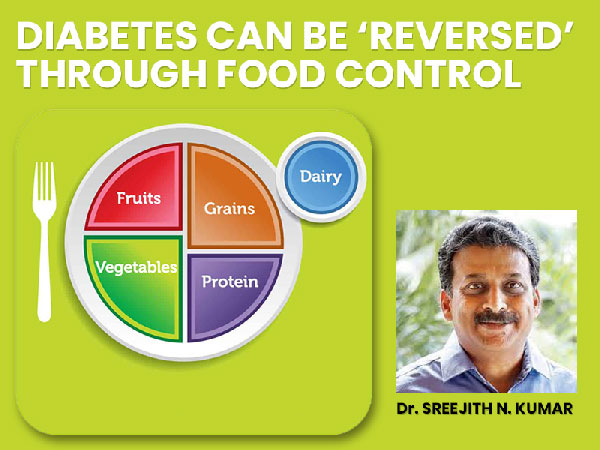
Change in food habits, with more emphasis on veggies and fruits, can work wonders in checking diabetes in general and completely reversing early-stage diabetes, well-known diabetologist Dr. Sreejith N. Kumar tells Ayurveda and Health Tourism correspondent N. S. Arunkumar.
N.S. Arunkumar: Would
it be true if we say that Diabetes begins at the kitchen?
Dr. Sreejith N.
Kumar: Absolutely true! For the simple
reason that the main cause of Diabetes is our food habits. Though we might say
that food habits of Keralites are related to our tradition, many aspects of what
has evolved as our food habits are scientifically wrong. The main component of
our ‘staple diet’ is carbohydrate (coming from rice), though there are a few
vegetables in the side dishes.
If we imagine a plate full of food, and
divide it into two halves, ¾ of the one half must be vegetables and ¼ of it
must be fruits. And, in the other half, ½ must be protein, and the other ½ only
must be grains. In addition to the plate, there can be 10% of milk products
also. Plant proteins are better than animal proteins. And, if we can follow
this ‘food plate’ we can resist and reverse diabetes.
Should this
‘food plate’ be there for all meals?
We must stick to this ‘food plate’
for all our three main meals. In short, it means that a major part of our food
must comprise of vegetables. Now carbohydrates constitute the major part. That
is not healthy. Food grains such as rice, wheat must be reduced, and tubers
also must be reduced as they are also rich in carbohydrates. The next point to
note is that oil and fat must be reduced to the least possible level. If we
change our food habits this way, we will certainly see it reflect in our body.
And, not to forget, we must devote at least 30 minutes every day for physical exercises.
Is it possible
to know in advance whether we are vulnerable to diseases like diabetes?
Yes, of course we can. Just remember
these numbers always: 70, 80 and 90. This denotes three points. The first point
is that among 70% of people, diabetes can be prevented. It may seem
unbelievable, but it is true! The next number is 80. It means that for women,
the circumference of the body at the belly level must be 80 cm or below it. It
can be measured using a tape which can be placed at the navel and winding it around
the body. If it is more than 80 cm, then it means that there is excess fat in
the body which can make you prone to diabetes. The last number 90 denotes the
same in the case of men. Their maximum belly-circumference must be 90 cm or
below. These are the ICMR findings.
What scientific evidence is there to
support your statement that food-control can help avert diabetes?
Of course, there are! In 2017, a
paper presented at the World Diabetes Conference by Mike Lean and Roy Taylor, two
scientists from England, who had conducted study on 300 patients. They divided
the 300 patients into two groups and for one group they gave the most modern
medicines available for diabetes and to the second group, they gave no
medicine, but asked them to control their food habits and reduce body weight.
After one year, it was found that in those who had reduced about 15 kg or more
of bodyweight, 86% were totally cured of diabetes. Even for those who could not
lose weight that much, there was reduction in the severity of diabetes.
Still, is it a
practical solution, especially in India and Kerala where we consume a lot of
grains?
Yes! The study conducted at my
Diabetes Research Centre, we have found it to be true. Ours was actually a
therapeutic programme named ‘SLIM’, which can be expanded as Structured
Lifestyle Intervention. We asked our patients to change their food habits to a
prescribed plan and, after three months, 72% of the patients who had participated
in this study could discontinue taking medicines for diabetes or reduce their
dosage.
We presented our data at the World
Diabetes Conference and it received wide acclaim. So, basically, it means that
if we can reduce intake of those food items which lead to the accumulation of
fat in the body, we can control a lot of diseases like diabetes, and
complications such as heart-attack, stroke, etc.
Can you be a
little more specific about the way carbohydrates result in increased chances of
a person developing diabetes?
See, carbohydrates are the main
content in food grains like rice and wheat. For every person living in India, it
is the main component of the daily food intake. It is carbohydrate that gives
us energy to perform various functions. But, all of us do not require the same
amount of energy as the nature of work each one of us does differs.
Normally, a person who is glued to
his chair requires only 20 calories of energy per kg of his/her bodyweight.
However, we don’t care about when we eat. The excess quantity of carbohydrates
(glucose) that we consume will get converted to fat, which will be deposited in
the body. If you have excess fat in your body, it simply means that you are
giving excessive stress to your insulin-producing organ. This may gradually
make it weak, and that will lead to diabetes.
How can we match
our energy requirements and the calories that we consume every day?
Keep this in mind. If we consume 100 grams
of rice, it gives us 180 calories. At the same time, 100 grams of cucumber
contains only about 17 calories! Similarly, 1 kg of vegetables contains only 200
calories. Now, look at fruits. About 100
grams fruits contain only 50 calories of energy. But, 1 kg of rice can give
1800 calories. Which simply means that if we don’t reduce the calories that we
consume, the excess calories will get converted to fat in the body. Excess fat
is unhealthy and can lead to many diseases including cardiac problems other
than diabetes and kidney disease. So, if you wish to live healthy, reduce
carbohydrate content in the food to the bare minimum and take more vegetables
and fruits.
Can a person
with diabetes take fruits?
Of course! Fruits can be there in the
diet. Apple, Orange, Pear (Sabarjilly), Guava (Peraykka) are safe for diabetes
patients as they are said to be low in ‘glycemic index’ and won’t lead to
sudden increase of glucose in the blood. About 100 grams of these fruits
contain only 50 calories. But, fruits like banana (nenthrappazham) and mango
contain more calories. ‘
What we need to do is to reduce the
amount of high energy fruits and increase those with low energy. For example,
one apple, one orange, one pear, one small plantain (cherupazham), half of a banana
(nenthran), half-a-guava fruit, half mango, one piece of pine apple, one piece
of papaya, four plums, and eight grapes can be taken as a mix. Also take care
to take more unripe fruits.
What would be
the ideal mix of fats and proteins in the food we consume?
As I have said earlier, a person with
normal body activities requires 20 calories of energy per kg of bodyweight. So,
normally for a person with 60 kg weight, the energy requirement will be 1200
calories. In this, only less than 50% must be from carbohydrates that means only
about 600 calories should be from carbohydrates. Of the remaining 50%, only 30%
should be from fats and 20% from proteins. When selecting fat containing food,
try to include nuts, oils like olive oil and fish as they contain unsaturated
fats which are less harmful. Saturated fats like mutton, beef, butter, etc.,
must be avoided as they release more energy.
What is the best
way to eat vegetables, raw or cooked?
That is important. We can eat them
raw, if it is possible. And some vegetables need to be cooked. However, when cooking,
try to bake or grill rather than frying them in oil. It is also important to
know that though we consider tubers as vegetables, they are rich in
carbohydrates. Their consumption must be reduced. For example, potato, yam
(chena) and colocasia (chembu). At the
same time, carrot and beetroot can be used in minimum quantities. Some
vegetables like tomato, capsicum and cucumber can be eaten raw. If you are
taking peas or grams (payar or kadala) try to make them sprout and then consume.
This is because germinating peas are low in energy.
Will it be possible
to ‘reverse diabetes’ by altering one’s food habits?
Yes, though it might look trying to ‘make
the impossible, possible’. Scientifically, the process is called ‘remission’ of
diabetes. Excessive fat accumulation in liver causes increased glucose
production. In pancreas, excessive fat causes ‘stress’ on beta-cells which
produce insulin. So, if excessive fat can be reduced, it can reverse diabetes.
However, this is possible only in
early stages of the disease and in obese people. In those people with
long-standing diabetes, especially in lean people, reversal cannot be fully
accomplished. But of course, dose of diabetes medications can be drastically
reduced. I would reiterate, it is all about following a ‘healthy food-plate’ as
the picture here shows. Stay healthy! Live longer! Bye!
Dr. Sreejith N. Kumar, MBBS, MD [General
Medicine]
DIP Diabetology, Diabetes Care Centre, K-5 Kochar Road,
Sasthamangalam, Thiruvananthapuram, Kerala-695 010
Phone: 7736011360,
E-mail: dccidea@gmail.com







