

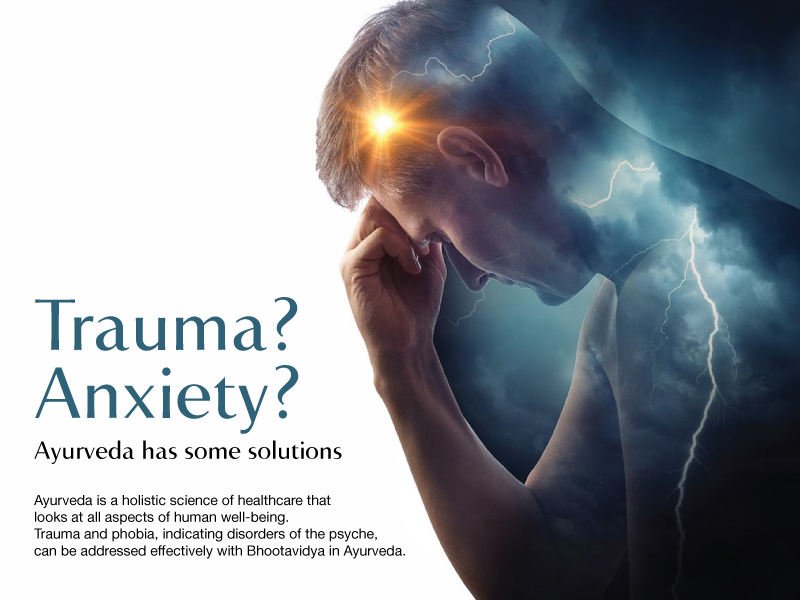
What is trauma and anxiety?
Seen from the perspective of Ayurveda, trauma and
anxiety happens when the mind is in dissonance with reality. This is described
as Pragnaparadha (literally ‘transgression against knowledge’). This
implies the unhealthy adaptation of the body and mind to situations resulting in
distorted thinking or lack of discernment. An unrighteous act done out of ignorance
and of impaired memory is non-volitional transgression.
Prajnaparadha can be
regarded as the channelling of vital energy into unnatural activities. This
energy can then take on an enduring form in either the body or the mind
resulting in derangement of senses and mind. The condition manifests fully as a
disease if disease-supporting factors ie., imbalance of doshas/humours)
prevail.
Mental blocks
There are inherent psychological hindrances that
obstruct clear thinking by deepening reactivity (rajas) and delusion (tamas).
There are five hindrances that afflict the mind. They are:
Avidya:
Ignorance of the true nature of things
Asmita:
Preoccupation with ‘self’ or ‘ego’ that leads to extreme subjectivity
Raga:
Passion
Dvesha:
Aversion
Abhinivesha:
Clinging to one’s beliefs, thoughts, emotions etc. or the inability to let go.
Line of treatment
The treatment in Ayurveda is geared towards mitigating
Vata Dosha, restoration of Sattva and the subordination of Tamas
and Rajas.
Management Trauma and Anxiety
Conditions of trauma and anxiety are managed well
with Ayurvedic healing herbs along with external treatments for the desired
period of time.
Healing Herbs
Ashwagandha and Brahmi
are the two best herbs, which help in the management of trauma and anxiety.
Brahmi
– Brahmi is by far the most important herb for treatment of
affective mood disorders. Its active principle, hersaponin, regulates brainwave
activity. It also contains iron, riboflavin, vitamin B6 and oleic acid. Because
the brain is the centre for creative activity, any compound that improves the
brain health is called Brahmi.
Brahmi, which
also means ‘bringing knowledge of the Supreme Reality’, has long been used
medicinally and as an aid to meditation. It is a revitalizing herb that
strengthens nervous function and memory and is classified as a Medhya
Rasayana, a drug used to improve memory and intellect (Medhya).
In the treatment of trauma and anxiety, Brahmi
is taken internally in the form of tea or powder or capsule or ghee. Brahmi
oil is applied to the head and to the soles of the feet at bedtime. It will
help calm the praanavaayu and bring sound sleep.
Ashwagandha– It is
used for mental problems and as a Rasayana (rejuvenator) in Ayurveda.
Scientists speculate that Ashwagandha‘s benefits stem from its
antioxidant properties and ability to scavenge free radicals. Two main classes
of compounds, steroidal alkaloids and steroidal lactones, may account for its
broad range of beneficial effects.
Steroidal lactones comprise a class of constituents
called ‘withanolides’. To-date scientists have identified and studied at least
12 alkaloids and 35 withanolides. Much of Ashwagandha‘s pharmacologicala
activity has been attributed to two primary withanolides, withaferin A and
withanolides D.
In one of the most complete human clinical trials
to- date-, researchers studied the effects of a standardized extract of Ashwagandha
on the negative effects of stress, including elevated levels of the stress
hormone cortisol. Many of the adverse effects of stress are thought to be
related to elevated levels of cortisol.
The results were impressive. The participants
subjectively reported increased energy, reduced fatigue, better sleep, and an
enhanced sense of well-being. The participants showed several measurable
improvements, Including a reduction of cortisol levels up to 26%, a decline in
fasting blood sugar levels and improved lipid profiles.
It would appear from this study that Ashwagandha
can address many of the health and psychological issues that plague today’s
society.
External treatments
External procedures help reduce trauma and reset
the nervous system. They also help in maintaining excellent health. Abhayanga
or therapeutic massage, foot massage, head massage and shirodhaara work
wonderfully in the management of trauma.
Abhyanga – Abhayanga
has been widely applied to improve health and reduce stress. Therapeutic
massage of the entire body using vata-pacifying oils like Ksheerabala
oil helps relax the body and mind, and is considered an essential part of
management of trauma.
Abhayanga is
therapeutic massage with moderate pressure on vital points, which helps in
relaxation as well as enhancement of blood circulation. Massage releases a
hormone called oxytocin, which is the “happy nurturing” hormone, precursor to
serotonin. Massage strengthens the muscles and stimulates the nervous system.
Research work on abhayanga or therapeutic
massage has shown that it enhances brain activity, thereby reducing anxiety and
stress.
Foot massage– Foot
massage with herbal oils help in relaxation and enhances blood circulation and
brain function. It stimulates all organs of the body, increases ojas and
a state of deep relaxation inducing a sense of total wellness in the entire
system. Massaging our feet, one of our five sense organs of action relieves insomnia
and nervousness.
Foot massage has been practiced over millennia as a
perquisite to sound sleep, to infuse the day’s activity with equanimity.
According to Ayurveda many marma points for the body’s vital
organs and sense organic are located in the soles of the feet. A peaceful
night’s rest or a calm day’s activity is assured after the feet are thoroughly
massaged.
Head massage– Head
massage increases flow of CSF, thus strengthening nervous system. This massage
balances pituitary and pineal glands. Eyes, heart, brain and colon also become
toned. It helps to improve experimental and cognitive memory alertness and
stability. It also strengthens the nervous systems and gives energy.
Shirodhara– Shirodhara
is commonly called as the third eye treatment. The Shirodhara is a
special treatment, where medicated oil is poured on the forehead and head in a
systematic manner. This is said to cure psychiatric and neurological ailments.
After a head massage, the soothing and fragrant oils flow in a continuous, rhythmic
stream for approximately 30 minutes over the forehead with the patient in the
lying position.
As the oil strokes the third eye, it has a
balancing effect on the deepest recesses of the brain, stimulating the
endocrine system, the pituitary and pineal glands (relieving hormonal turbulence)
and pleasure neurotransmitters (relieving anxiety, trauma or emotional
insecurity). The procedure is also said to synchronize alpha brain waves,
enhancing blood circulation to the brain, improving mental clarity and
generally releasing deeply trapped toxins (called Ama in Ayurveda).
It releases serotonin and encourages a balance of mind body and spirit.
The herbal ingredients in the medicated oils are
absorbed through the skin and enter the blood stream, emphasizing the
neurological effect of Shirodhara further. Shirodhara is a deeply
nurturing psycho-spiritual experience that attunes the body/mind towards
spontaneous healing. It is based on the principle that gentle but constant
application of warm oil stimulates healthy blood circulation of the brain. All
mental problems such as anxiety anger or irritability dissolve into an ocean of
calmness as the mind is lulled into a state of serenity and expanded
consciousness.
Shirodhara is
deeply stress-relieving, pacifies vata while nourishing and calming the
nervous system. It cleanses the mind and senses of negativity and improves
mental clarity and cognition. Shirodhara offers a profound healing
effect on the nervous system.
Healing herbs and external treatments when
continued for a longer period of time, along with changes in daily routine like
finding time to practice yoga, meditation and pranayama, will help in
restoration of mental health and will help in maintaining physical and mental
well-being.
Meditation –
Medication focuses concentration and keeps anxiety away and is effective in
lowering the levels of trauma. Mantra or the repeated chanting of the
sacred hymns, is also a good way to calm and focus the mind preventing it from
going back into the past. Yantra or gazing at a sacred symbol or Trataka
(Gazing at a candle flame for 5 minutes) will also help the mind to say in the
present and focused. Concentration on the breath helps in preventing the mind
from wandering. When we are disturbed or anxious, the breath is irregular and
interrupted. Meditating in padmasana posture is the best method to
relieve physical, nervous and mental problems. Meditation can also be done in
any comfortable posture.
Pranayama – Prana
is the bridge between body, mind and consciousness. Thus, prana and the mind
are deeply connected. Physical manifestation of prana is the breath.
Every thought changes rhythm of the breath and every breath changes the rhythm
of thinking. Pranayama helps clean the nadis (vital energy channels) so
that more oxygen and energy is conserved in the body. This allows a more
peaceful state of mind by completely reducing mind activity, so that anxiety,
stress and negativity are removed. This is effective in all kind of traumas and
is the path towards self-realization. It minimizes the impact of irritation,
restlessness and impatience after trauma or stress.
Yoga– Yoga
helps maintain a healthy nervous system. Yoga is a system that brings
about harmony between the body and the mind, which is so badly needed in
today’s active and complex world. Yoga plays a big role in relaxing the mind,
thus strengthening mental health and producing vital energetic readjustments.
By achieving overall mental health, yoga helps a
person to recover from physical traumas and emotional blocks. Yoga
postures ensure purified oxygen and prana intake and help balance blood
circulation and supply to brain. These actions are thus beneficial for recovery
from trauma and for the improvement of one’s mood.
The psycho-spiritual practices of yoga facilitate
the removal of the hindrances that afflict the mind, thereby ending the inner
psychological conflict of the gunas. This, in turn, enables the
individual to let go and accept life and its dualities with equanimity. This
return to the lost harmony and peace is the restoration of ‘sattva’ or victory
over the mind’s turbulent state.
Yoga
postures like padmasana (Lotus pose), Shavasana (Corpse pose), Shirshasana
(Head stand), Sarvangasana (Shoulder stand), Matsyansana (Fish
pose), Shalabasana (Locust posture), Ardhamatsyedrasana (Sitting
half spinal twist pose) help in maintaining balance in the nervous system.
Essential oils – They
are extensively used in Ayurveda as they have a powerful effect on doshas.
Lavender oil can be smelt for emotional crisis. It can also be used for
self-massage once a week. Research has proved the effects of lavender on the
nervous system.
It is thus evident that Ayurvedic treatments
are effective in mitigating psychological disorders. Ayurvedic treatments,
coupled with proper diet and lifestyle, can help reduce anxiety disorder, panic
attacks, post-traumatic stress, etc.
Our
diet and life-style affect our emotions and can create a predisposition for
both psychological and physical disorders. Mind stays healthy only when the body
is healthy and vice versa. So, in order to keep the mind and body in a healthy
state, one should follow a proper diet and life-style that are in tune with the
Ayurvedic principles.







