

Practicing Yoga is one of the best things you can do for the health of
your lungs. Yoga strengthens chest muscles, increases lung capacity and
enhances oxygen intake. Noted Yoga Guru Kaithapram Vasudevan Namboodiri
explains various Yogic practices that keep your lungs healthy.
The respiratory system is a network of organs and tissues that help you
breathe. It consists of two lungs, air passages and blood vessels. The lungs
are located in the upper thoracic cavity of the chest, one on each side of the
median line, and are separated by the heart, the Great blood vessels and the
even larger air tubes. The lungs are spongy, porous and their tissues are
elastic, containing innumerable air-sacs or alveoli. Each lung consists of an
apex and a base. The base is directed towards the diaphragm, the dividing
muscular wall between the chest and the abdomen.
The vital force prana is the life force of all beings. Prana
is subtle and breath is gross. Prana is manifested through breath.
So the health or wellness of the respiratory system is vital for an individual
to be healthy and disease-free.
First of all the whole respiratory system should be cleansed so that
breathing will become effortless and easy. There are six types of cleansing
techniques in Yoga called Shad (six) Kriyas — neti, dhouti,
nouli, basti, trataka and kapala bhati. Neti and kapala bhati
are connected with the respiratory system.
Neti
Neti is for cleaning the nasal passage with water (jala) or string (sutra).
Jala Neti
Now-a-days Neti-pot is available with yoga centres. Fill the pot
with lukewarm water and add a little salt to it. Insert the nozzle of the pot
into the right nostril. Keep the mouth open and breathe freely through the
mouth. Tilt the head first slightly backwards and then sidewards to the left so
that the water from the pot enters the right nostril and comes out through the
left by gravity. Allow the flow till the pot is empty. Repeat the same with the
left nostril. After that, blow out the water by forceful exhalation through
alternate nostrils.
Sutra Neti
Here, rubber catheters are used instead of string. Insert the blunt end
of the thin soft rubber catheter horizontally to the right nostril. Gently push
it inside until the tip is felt in the back of the throat. Open the mouth and
catch hold of the tip of the catheter at the back of the throat. (Practitioner
can make use of a mirror) Pull it out through the mouth and gently massage the
nasal passage by catching the two ends of the tube. Then remove the catheter
through the nose. Repeat the same on the left side.
Kapaalabhaati
Kapaala is skull and bhaati means shines. Here, the skull is the nasal
passage through which the air passes in and out. This is a breathing exercise
that makes the skull shine. Forceful exhalation and passive inhalation is the
practice done here.
Sit in a cross legged position, with the back straight and the head
erect. Take two or three deep breaths as preparation. Contract the abdominal
muscles quickly causing the diaphragm to move up into the thoracic cavity and
pushing the air out of the lungs forcefully. Then relax the abdominal muscles
allowing the diaphragm to descend into the abdominal cavity. Now passive
inhalation takes place. Repeat this pumping quickly for 20 to 30 times. Then,
have two or three deep breaths and after retention of 30 to 60 seconds, start
the second round of pumping.
Breathing practices
To improve and increase the capacity of lungs, there are exercises
making use of the movements of hands. These are also called Yogic exercises (yougika
vyayam).
1. Stand erect and stretch out the arms in front in level with the
shoulders and bring the palms together. While inhaling, spread the arms
sideways in the horizontal plane. While exhaling, bring the arms forward with
the palms together. Repeat this several times. The movements of the hands and
the breath flowing in and out should be synchronising, slow and rhythmic.
2. Stand erect and bring the palms on the chest and interlock the
fingers. While inhaling, stretch the arms forward horizontally and also twist
the hands so that the palms face outwards. While inhaling, reverse the process.
Repeat it five times.
Repeat the same movements with the arms now stretching above forehead at
an angle of 135 degree. Repeat the same, stretching the arms vertically above
the head. While moving up and down, the palms should touch the tip of the nose.
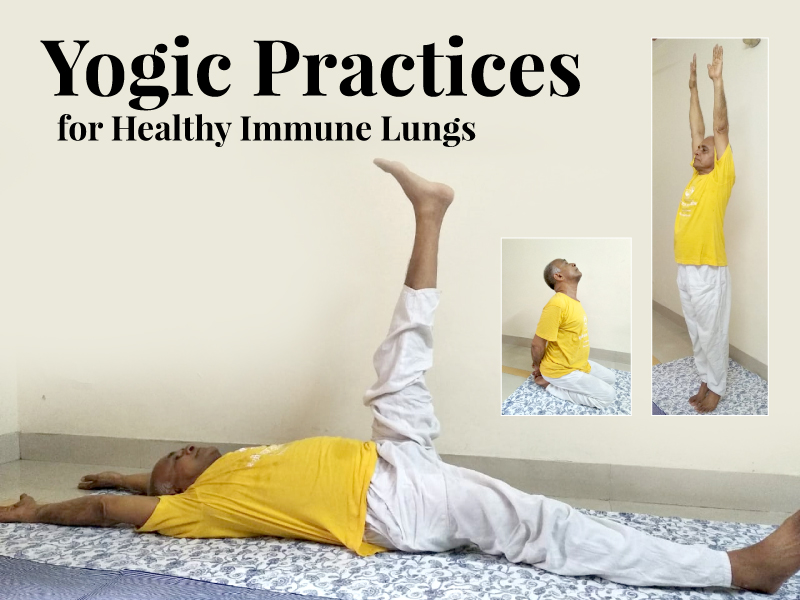
3. Stand erect with the palms in front of the thighs. While inhaling,
stretch and raise the hands through front above the head and also stretch the
ankles up. Hands should be parallel to each other and the palms looking
forward. And when exhaling, bring the hands and heels down.
There are many more such practices like Dog Breathing, Rabbit Breathing,
Tiger Breathing, Sasaankasana Breathing, Leg-raise Breathing etc. by
which the capacity and immunity of the lungs can be increased.
Dog Breathing
Sit in vajrasana. Place the palms of the hands on the ground,
beside the knees. Mouth opened wide, tongue pushed out to its maximum, practise
rapid and forceful inhalation and exhalation expanding and contracting the
abdomen vigorously like a dog. Repeat it for 30 seconds and relax in savasana.
Rabbit Breathing
Sit in vajrasana. Bend forward and rest the forearms on the
floor, keeping the elbows by the side of the knees and palms flat on the
ground. Open the mouth partially and protrude the tongue partially. Pant
quickly like a rabbit. Do it for 20 to 40 breaths. Then relax in savasana.
Tiger Breathing
Sit in vajrasana. Lean forward and place the hands flat on the
ground in line with the shoulders with the fingers pointing forward. Arms,
thighs and heels should be one shoulder width apart. Arms and thighs are
perpendicular to the floor. While inhaling, raise the head and look at the
ceiling, spine in concave position. Exhale and arch the spine upwards and bend
the head downward bringing the chin towards the chest. Repeat it five times and
relax.
Sasaankasana Breathing
Sit in vajrasana. Take the hands behind the back, make a fist of
the right hand and hold the right wrist with the left hand. Relax the shoulders.
While inhaling, bend backwards while looking up. While exhaling, slowly bend
forward and bring the forehead on the ground. Relax the shoulders. Inhale
slowly and come to the vertical position. Continue for ten rounds and relax.
Leg-raise Breathing
Lie down in supine posture. While inhaling, slowly raise the right leg
without bending the knee, if possible to the vertical position. While exhaling,
return the leg to the floor as slowly as possible. Repeat the same with your
left leg. Do it ten rounds and relax.
ABOUT THE AUTHOR
Kaithapram Vasudevan Namboodiri,
MSc.Yoga, UGC. NET. Yoga.
AYUSH-certified Yoga Teacher and Evaluator.
MA. English, MEd.
e-mail: vasumash@gmail.com
Contact: 9447077203