

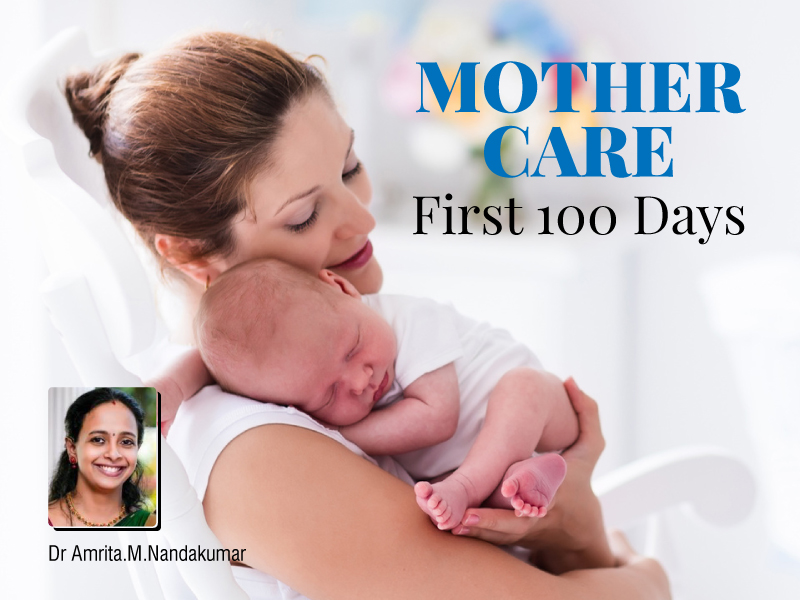
Woman is a unique creation of god, blessed with the gift of Motherhood.
Ayurveda emphasis on providing care for Stree (women) at every phase of
her life – may it be Rajaswala Paricharya (menstrual care), Garbhini Paricharya
(antenatal care) or Sutika Paricharya (postnatal care).
In Ayurveda, the term ‘Sutika’ refers to a woman who gives
birth to a baby along with placenta – an organ that develops in the uterus
during pregnancy. The placenta, which provides oxygen and nutrients to the
growing baby and removes waste products, attaches to the wall of the uterus,
and the baby’s umbilical cord arises from it.
The age-old medicinal system advocates equal care for mother as well as
baby during the first hundred days. Remarkable changes take place in a mother
during this period as it enables her body to revert to the non-pregnant state.
It’s a period when she restores her health and mental strength. She has to
learn how to take care of herself and her baby. Therefore she needs special and
proper care during this period.
Mother care includes Ashwasana (psychological
reassurance). The women, after the delivery of their babies, should be
encouraged by sweet spoken words. It’s a kind of satvavajaya chikitsa (Ayurveda
psychotherapy). It is a process of mental boosting to let her prepare to take
care of herself and the baby.
Snehana (Oiling) and mardana (Massage) – In Bruhatrayi and
Kashyapa Samhita, it is mentioned that the women after delivery should
be given a whole body massage. Acharya Sushruta, Vagbhata and Sharangdhara
advocate the use of Bala taila, the traditional massage oil, for the
full massage while Vagbhata advised yoni abhyanga (vaginal
oiling).
The purpose is to relieve the pain at the back, flank and abdomen,
caused due to the delivery. It also helps in expulsion of residual clot in the
uterus. Yoni Abhyanga helps to tone the vagina and perineum.
Patta Bandhana (abdominal compression) – Acharya Charaka, Vagbhata, Kashypa and Yogratnakara
say the abdomen should be properly wrapped with a clean cloth to compress the
abdomen and prevent the vitiation of vayu, likely to occur due to
availability of hollow space. This also helps in the uterus regaining the
normal size.
Yoni Dhupana (vaginal fomentation)- It helps in relieving pain and
inflammation caused by local tears during labour or due to episiotomy and
hastens healing process. According to Acharya Kashyapa, Swedana
(steam treatment) to yoni should be given with drugs like Oleo
prepared with Priyangu. Fumigation with Kushta, Guggulu and Agaru
mixed with ghrita is also widely recommended. Due to fomentation, blood
flow of the local area is increased via vasodilatation. All these drugs have
essential volatile oils which have strong antiseptic and disinfectant
properties against streptococci and staphylococci, thus preventing infection.
Snana (hot water bath)- Acharya Charaka ,Sushruta, Kashyapa and
Harita prescribed hot water bath followed by rest for sutika.
Prohibited panchakarma (purification) therapies – Use of asthapana-basti
(enema), siravedha (venesection), nasya
(administration of herbal formulation through nose), virechana
(purgatives) and svedana (sudation) – are contra-indicated, however, Sharangdhara
has advised svedana (sudation)following delivery. Asthapana basti
(type of basti where decoction is the major part) is contraindicated because it
increases ama dosha. Nasya given to post-natal women can cause
emaciation, anorexia and body ache.
Apathyas (don’ts) for Sutika — Krodha (anger), Maithuna
(intercourse), Diwaswapna (day sleep), Asatmya Bhojana (incompatible
food), Sheetala Jala (cold water) etc.
Sutika (puerperal women) are already exhausted, so vyayama is
contraindicated. The reproductive tract is already lacerated and weakened so maithuna
is contraindicated; Consumption of cold things and physical works aggravates vata.
Emotional imbalance like anger, fear, depression badly affects the lactation. Mithyaachara
(inappropriate physical and mental behaviour) during this period results in
incurable diseases.
Dietary regimen
Panchakola Phanta can be given as Dhatushaithilyahara (improves dhatus), deepana,
pachana (enhances digestive fire) and shulaghna (relieves pain).
Ghrita is considered as yogavahi. It strengthens the digestive system (vatashamana).
Jaggery- mamsa & raktavardhaka support digestive power
as well as balance vata.
Decoction of laghupanchamula dravya is advised as it is vataghna,
brihmana, balya,deepna , mutrala and jwaraghna .
Rice gruel prepared with vidaryaganadi gana and milk aids fast
recovery during the puerperal period.
Liquid diet like yavagu- Tarpana, vatashamaka
Mamsa rasa – source of iron, vitamin, essential amino acid, and trace
element.
Kulatha– Cleanses abnormal blood through the uterus besides decreasing kleda.
In modern science it is told that the patient should be on a normal diet of her
choice, if the patient is lactating high calories, additional protein, fat,
plenty of fluids, mineral, vitamins are to be given.
Importance of Mothercare
1. It Increases psychological alertness, apparent thinking and emotional
steadiness
2. Strengthen and improve digestive power.
3. Helps a woman’s body reverse back to her normal pre-pregnancy shape.
4. Promotes breast feeding.
5. Accelerates the involution process.
6. Protects her from various diseases.
Sutika Paricharya explained in Ayurveda deals with the post-natal care in a meticulous
fashion and in scientific view, focusing on every aspect required to replenish
and restore health of a woman and avoid postpartum complications.
About the Author:
Dr Amrita M Nandakumar
BAMS, MS (Ayu)
Medical Officer
Triveni Nursing Home,
Trivandrum
Mobile – 9847385044
dramrita712@gmail.com







