
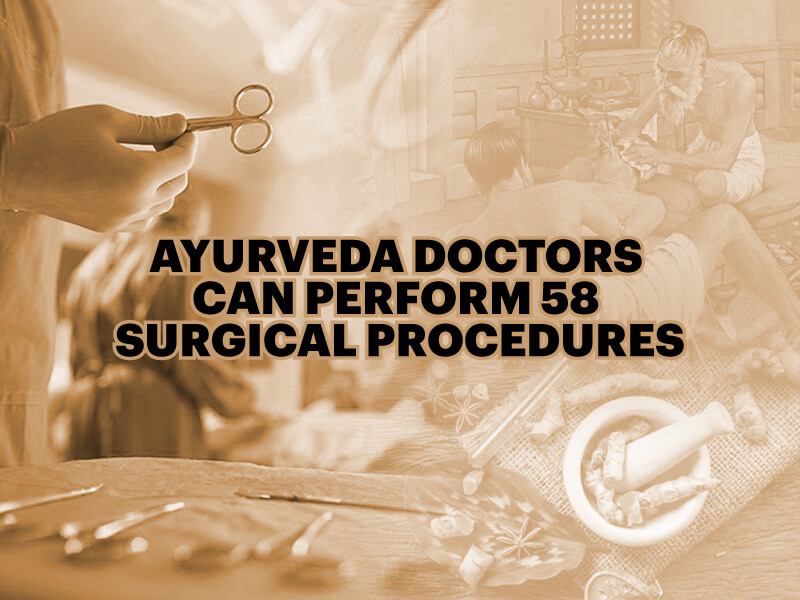
Post Graduate Ayurveda scholars can independently perform a
total of 58 surgical procedures after appropriate practical training and completion
of their PG Degree.
The AYUSH Ministry specified this in a clarification issued
on Sunday on the “nature and purpose” of the ‘Indian Medicine Central Council
(Post Graduate Ayurveda Education) Amendment Regulations 2020’ issued by the
Central Council of Indian Medicine (CCIM), the statutory body that regulates
the Indian Medical systems of Ayurveda, Siddha, Sowa-Rigpa and Unani Medicine.
“The notification relates to the Shalya and Shalakya
streams of Post Graduate Education in Ayurveda. The notification specifies (in
clearer terms than the earlier notification on the subject) a total of 58
surgical procedures that PG scholars of these streams (cumulatively) need to be
practically trained in so as to enable them to independently perform the said
activities after completion of their PG Degree. The notification is specific to
these specified surgical procedures and does not allow Shalya and Shalakya Post
Graduates to take up any other types of surgery,” it clarified.
Since beginning, Shalya
and Shalakya are independent departments
in Ayurveda colleges, performing such surgical procedures. While the earlier
notification of 2016 stipulated that the students shall undergo training of
investigative procedures, techniques and surgical performance of procedures and
management in the respective specialty, the details of these techniques,
procedures and surgical performance were laid down in the syllabus of
respective PG courses issued by CCIM, and not the regulation per se.
The present notification “was issued in over-all public
interest by CCIM by bringing the said details into the regulation. Hence this
does not signify any policy shift,” the ministry said.
Earlier, the Indian Medical Association (IMA) openly opposed
the policy, claiming the move would result in a “khichdi medical system”.
The IMA said it stands for purity of systems of modern
medicine as well as Ayush and warned the new system will provide “hybrid
doctors” and the choice of the patient is effectively nullified.
“It’s not in the interest of traditional systems either
to lose their identity and further development. As such 96 per cent patients in
IPD (inpatient department) and 94 per cent of patients in OPD are being served
by modern medicine. Currently, a patient has the choice of choosing either
modern medicine or alternative system as per their desire,” said Dr Rajan
Sharma, national president, IMA.
“…The question of “mixing” of Ayurveda with Conventional
(Modern) Medicine does not arise here as CCIM is deeply committed to
maintaining the authenticity of Indian systems of medicine, and is against any
such “mixing”,” the clarification statement by the AYUSH Ministry read.