

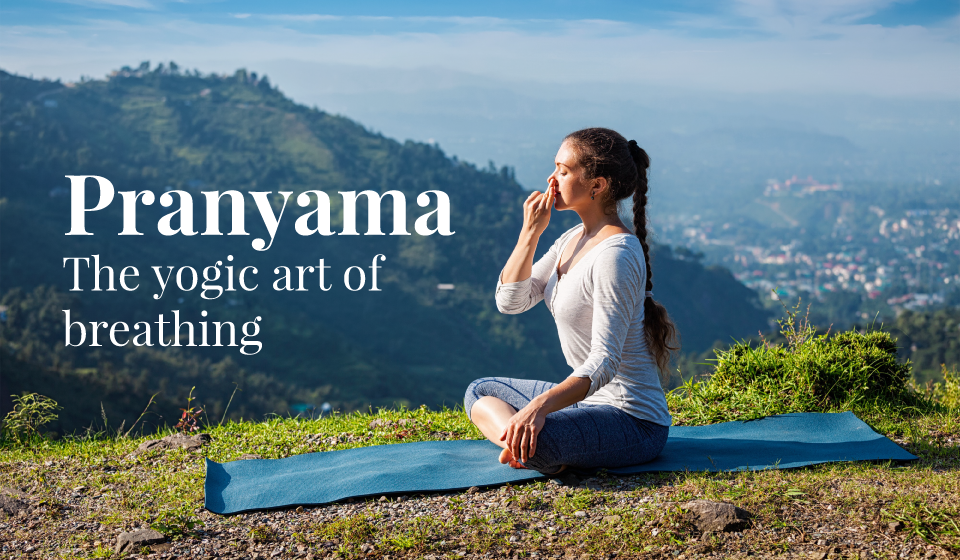
Many people are unaware of the
importance of proper breathing and use only a fraction of their breathing
capacity. This results in inadequate supply of oxygen, especially to the brain,
which may cause degradation of vital organs. The practice of ‘Pranayama’
helps one to fully utilize all lobes of the lungs and to normalise the
breathing rate.
Brain requires more oxygen than
any other organ and its inadequate supply may result in mental sluggishness,
negative thoughts and depression. The elderly lot faces this problem more
often. Proper oxygen supply is also essential for the body to metabolize food
efficiently and to get rid of all the noxious by-products, especially
carbon-dioxide.
Often what’s wrong with breathing
in many persons is that it’s too shallow and quick. The rising stress of modern
life and the resultant negative emotional states affect the breathing rate. The
result is oxygen starvation and a toxic build-up.
The importance of proper breathing
was realized thousands of years ago. Hata Yoga Pradeepika says thus: ‘As
long as there is breath in the body, there is life. When breath departs, life
also departs. Therefore regulate the breath.’
The yogic art of breathing is
called Pranayama (controlled intake and outflow of breath). Prana
is usually translated as breath, though this is only one of its many
manifestations in the human body. “He who knows pranas knows veda’
– say Upanishads. Prana is the sum total of all energies that is
manifest in the universe. It is the sum total of all the forces in nature. Prana
is not the air itself but the subtle life-giving element extracted from the
air. The more life-force you have in your body, the more ‘alive’ you are.
Ancient sages knew that all bodily
functions were performed by five types of vital energies (five pranas).
And according to Yogis, prana, mind and breath are very closely
connected. It’s prana that makes the lungs capable of breathing and when
we breathe in, we’re receiving the cosmic prana, which energises the
whole body. The practice of Pranayama regulates the flow of prana
throughout the body. It also regulates the thoughts of the practitioner and
bestows him with a calm mind.
An average person takes around 500
cubic centimetres of air during normal inhalation. But in deep breathing, the
intake of air is increased upto 3000 cubic centimetres, about six times
greater. With the practice of Pranayama, the respiratory system
functions at its best and as a result, the circulatory system also functions
more effectively. And the resultant better detoxification opens the doorway to
good health.
With Pranayama, one can
fully utilise all lobes of the lungs and normalise breathing rate. He learns
how to make the breathing uniform, continuous and rhythmic. Following are some
of the basic practices for those who wish to learn pranayama. These can
be practiced even by aged persons.
Abdominal breathing
Sit comfortable in a cross-legged
position on the floor or lie flat on your back in the corpse pose. You can
place one hand on the abdomen to feel it rising and falling. Relax your mind
and body. Inhale slowly and deeply through the nose, feeling your abdomen
expand and rise while keeping the chest still. As you exhale, feel the abdomen
sink down. When you inhale, expand the abdomen and contract it when you exhale.
Practice this exercise for 10 cycles (one cycle equals one inhalation and one
exhalation).
Benefit: Breathing slowly and
deeply brings air to the lowest part of your lungs and exercises your diaphragm
which can greatly enhance breathing capacity. It relaxes mind and body,
massages internal organs, calms emotions and induces good sleep.
Rib cage breathing
Sit comfortable in a cross-legged
position on the floor or lie flat on your back in Savasana. Hands may be
relaxed by the sides or you can place hands on the sides of the ribs to feel
them expanding and contracting. Gently contract the abdomen. Inhale slowly
through the nose into your rib cage. Don’t pull the breath deep into your
lungs, but keep it focussed between your ribs. Feel the ribs expand outward and
the chest open as you breathe in. As you exhale, feel the ribs contract inward.
Repeat five times.
Benefit: Relaxes the mind and the
body and strengthens lungs.
Complete breathing
Sit comfortable in a cross-legged
position on the floor or lie flat on your back in the corpse pose. Place one
hand on the abdomen and the other on the rib-cage to check your breathing.
Inhale slowly through the nose, feel the abdomen expand first, then the rib
cage, and finally feel the air filling the upper chest. Your abdomen will
automatically be drawn in as the ribs move out and chest expands. Slowly
exhale, emptying the lungs from top to bottom. Keep the body without jerks. Try
to make inhalation and exhalation uniform. Don’t hold your breath in between.
Inhalation is done from the bottom up and exhalation from the top down. Repeat
five times.
Benefit: helps reduce tension and
stress in your life. You can use it anywhere, anytime to calm your mind and
body. Use this technique to centre yourself before your meditation and before
asana practice to make them even more effective.
Proper practice of Pranayama
with Yoga asanas can give you wonderful results but at the same time if
done wrongly, it can have long lasting adverse effects in your body. Pranayama
comes as the fourth stage in the Ashtanga Yoga, where the previous ones
require complete control of the mind and the body. In Pranayama, one is
dealing with the basic energy of the self and to master that one has to go
miles and miles.
(The author MP Jayadevan is a
Yoga-ReiKi trainer)







