

Widespread use of medicinal herbs for healthcare preparations
has been documented in ancient texts from the Vedas to the Holy Bible. One such
wonder plant is Aromatic ginger (Kacholam),
scientifically known as Kaempferia galangal, a member of the ginger family
(Zingiberaceae).
Known as ‘Chandramulika’ or ‘Sati’ in Ayurveda, Kacholam finds mention as a key herb
used in treatment of various respiratory ailments. The plant is native to South
India. Thanks to its economic potential, the plant is cultivated extensively in
Kerala and other parts of India. Nowadays, it can be seen rarely in natural
forests and is more often cultivated.
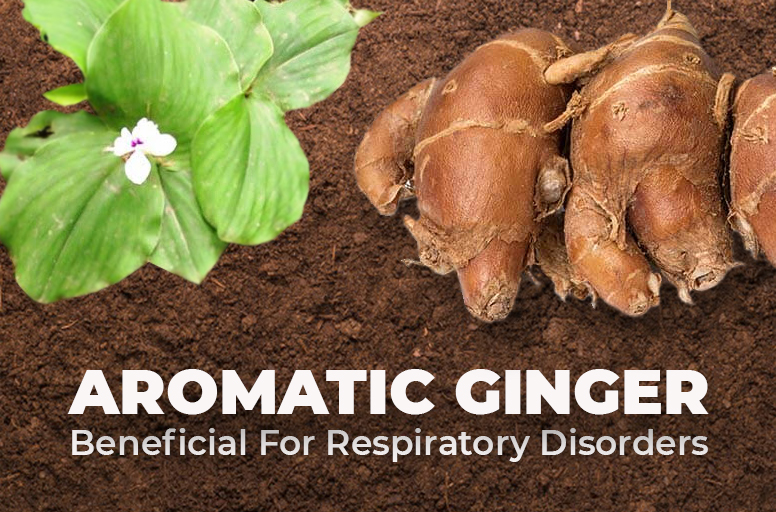
The plant, a perennial herb with underground stem, is pleasantly
aromatic. Two or three leaves are only seen at a time, which spread flat on the
ground. Leaves are rounding ovate with a small stalk. The plant blossoms during
August to September, with small white flowers having purplish spots. The aerial
portion dies down to the ground level during unfavourable seasons and fresh shoots
are formed before or at the beginning of the rainy season, ie from May to June.
The underground stem or rhizome has an agreeable fragment smell
and a somewhat warm bitter taste. The rhizome consists of one or more
prominent, fairly big, vertically oriented tuberous root stocks together with
several smaller secondary tubers and a cluster of roots most of which are long
and narrow while a few are shorter and tuberous at their tips. The main tuber
is vertically oriented, conical in form, wider below, narrower at the tip and
distinctly marked with a number of transverse scars. Directly attached to the
main tuber are a limited number of smaller tubers, also vertically oriented.
All these together form a large bunch that may weigh upto one kilogram.
The rhizomes are chopped into slices and dried. The dried
rhizome possesses the characteristic agreeably strong odour and pungent taste
sometimes to a slighter degree.
Chemical composition
Steam distillation of the triturated rhizome gives 2.4 to 3.88
per cent of volatile oil. The following compounds have been reported to be
present in the oil — ethyl pethoxycinnamate (30%), ethyl cinnamate (25 %),
n-pentadecane, camphene, borneol and p-methoxystyrene. The oil from the rhizome
is not produced on a commercial scale. Among the volatile oils, ethyl cinnamate
is a vasorelaxant. The anti-fungal action of ethyl p-methoxycinnamate has been
reported.
Medicinal uses
The rhizome of Kacholam
is considered stimulating, expectorant, carminative and diuretic. It is used in
the preparation of gargles, administered with honey for treatment of coughs and
pectoral affections. Boiled in oil, rhizomes are applied externally to remove
nasal obstructions. Roasted rhizomes are applied hot in rheumatism and for
hastening the ripening of inflammatory tumour. They are also used as a wash in
dandruff and for relieving irritation produced by stinging caterpillars.
Mixed with oil, the rhizomes are used in quick healing of
wounds. One or two drops of the extract of fresh rhizome and garlic will be a
good remedy for expelling intestinal worms in children. If chewed and
swallowed, it is said to be a hallucinogen with no recorded ill effects.
The juice of the plant is an ingredient in many tonic
preparations. Leaves are used in lotions and poultices for sore eyes, sore
throats, swellings, rheumatism and fevers. Fresh rhizome is chewed to remove
the unpleasant odour of the mouth. Along
with honey, the dried powdered rhizome is administered in the treatment of
vomiting and nausea.
Commercial uses
The herb is used for flavouring rice. Rhizomes and leaves are
employed as a perfume in hair washes, powders and other cosmetics. They are
worn by women for fragrance and also used for protecting clothes against
insects. They are eaten along with betel and areca nuts as a masticator.
(The author Jacob Varghese is a botanist and can be contacted
at jacobkunthura@sancharnet.in)