
In Ayurveda, snehana nasya, or
oiling of the nasal passages, has been used for thousands of years to prevent
and treat many causes of physical and mental imbalance. In these times of covid-19
(and in a world now literally awash with air-, water-, and earth-borne toxins
and stresses), snehana nasya has perhaps
never been so important. Noted Ayurveda practitioner Dr Susie Colles writes…
Applying warm oil inside the nostrils provides a
thin moist coating that can catch airborne particles before they enter the body. In this way, snehana nasya can prevent the influx of viruses,
bacteria, yeasts, pollens and other allergens and elements that can challenge
and disrupt the body. It helps to prevent virus infection, colds, flus and
allergic rhinitis (hay fever).
Oiling and
moistening the nasal passages also helps to protect, lubricate, nourish, strengthen and clean
the sensitive tissues of the nostrils, mucus membranes and paranasal sinus. The Charaka Samhita
and Bhavaprakasha state that persons habituated to nasal oiling
acquire good vision, smell, and hearing; a sweet and pleasant voice and breath;
and avoid wrinkles and grey hair, stiff necks and headaches.
As the
nose is the gateway to the brain, snehana
nasya also helps to nourish and clarify the mind and senses and support the
cerebral tissues. It can help to improve sleep and snoring issues, and benefit
breathing and the yogic practice of pranayama.
Within the
dinacharya or daily routine, all Ayurvedic
constitutions can benefit from snehana
nasya. In the morning, nasal oiling helps to remove excess congestion and kapha. In the heat of the day it can
help to cool pitta. In the evening snehena nasya helps to mitigate the
dryness of vata. Specifically, snehana nasya works on prana vayu, bodhaka kapha, tarpaka kapha
and sadhaka pitta.
How to practice:
— Use
warm oil as advised by your Ayurvedic
practitioner. Various options include:
Untoasted,
cold-pressed sesame oil – good for vata
constitution and good for general use
Plain ghee (clarified butter), or coconut oil
– good for pitta constitution
Extra
virgin olive oil – useful for pitta
and kapha constitution
Or
medicated, herb-infused oil such as:
Anu tailam — pungent oil with a strong
cleansing effect – good for kapha constitution
(It can also be diluted with extra sesame oil for congested vata types).
Bramhi ghee or oil – good for pitta constitution,
and if one does intellectual work.
— Warm
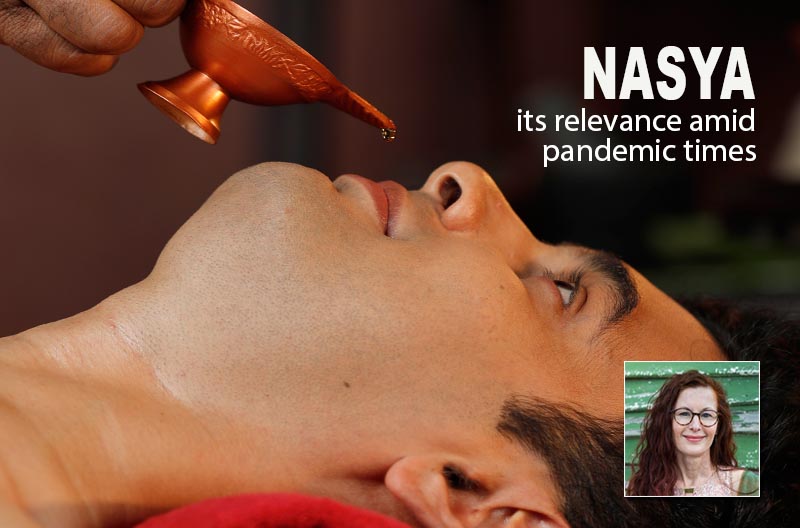
a small amount of oil on a teaspoon and take a little onto a clean pinkie or
ring finger or on to a cue tip or take it into a glass dropper (if applying from
a glass dropper, tilt the head back or lie down; it may help to hold a small
mirror).
— Administer
1 to 4 drops of oil into one nostril.
— Block the
other nostril and sniff gently and deeply.
— Repeat the
oil administration and inhalation on the other side.
— When
administering snehana
nasya it is advised to stay warm and
avoid over-stimulation of the sense organs.
In
general, one can apply oil to the nasal passages twice a day—morning and
evening. A good time to administer oil is after bathing or showering. But snehena nasya can also be performed when
and as needed, according to an individual’s constitution,
circumstances and season. For example, those with kapha dominance may best use a small amount of pungent oil such as anu tailam, and during warm, moist
seasons need not apply oil daily. If congested, kapha types can also use steam to help loosen nasal, sinus, throat
and lung congestion. Vata types, who
are constantly prone to dryness, can benefit from nasya year-round, and may apply oil more regularly in dry, and very
hot and very cold seasons.
Amid the world pandemic threat covid-19, it’s advisable to use snehana nasya as part of the daily routine to bolster good health
and immunity, and reduce your risk of infection.
References:
Dash,
B. and Sharma, R. K. (transl.) Caraka Sam.hitā, vols; I—VII, Varanasi,
Chowkhamba Sanskrit Series; 2015 reprint.
Ministry of AYUSH Ayurveda’s immunity boosting measures for self care
during COVID 19 crisis. Available at: https://www.mohfw.gov.in/pdf/ImmunityBoostingAYUSHAdvisory.pdf
Murthy,
S. K. (transl.) Bhāvaprakā ā, vols–II, Varanasi, Krishnadas Academy;
1998.
Public Health Approach of
Ayurveda and Yoga for COVID-19 Prophylaxis. J
Alt Compl Med. May 2020.360-364. http://doi.org/10.1089/acm.2020.0129