

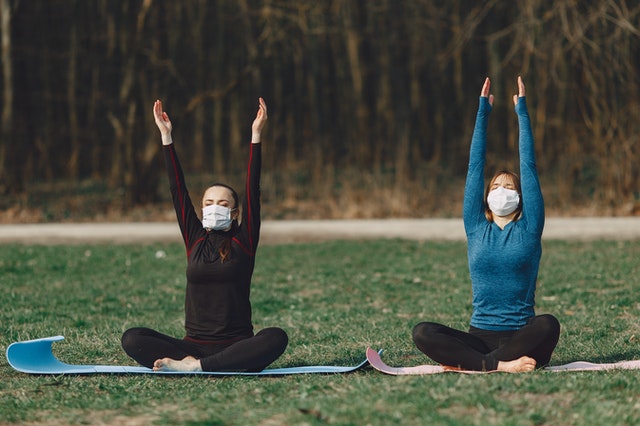
The ‘International Yoga Day’ on Sunday saw millions embracing
the ancient healing system, a sign that people across the globe have started
recognising its multiple health benefits. The total mind-body workout is all
the more relevant in the current situation when the world is reeling under the Covid-19
pandemic. Dr Remya Jayakumar, MD Scholar,
Department of Rasa Shastra and Bhaishajya Kalpana, Banaras Hindu University,
explains the importance of Yoga in our post Covid-19 lifestyle.
The novel coronavirus continues to spread across countries with
some even battling a second wave. However, a cure for the disease is yet to be
found by researchers toiling hard in dozens of laboratories across the globe. Whatever
be the future, there will be some lifestyle modifications that people would have
to live with. Habits like wearing masks and frequent hand washing are to remain
with us for an unforeseeable time. Yoga too can be made part of our lifestyle as
a tool to keep the viral infections at bay.
The Yogic science comprises of two traditions — Hathayoga and Rajayoga. If Hatayoga is
the ladder or preparatory stage, then Rajayoga
is the throne. In Hatayoga, the
eightfold path or pillars — Yama,
Niyama, Asana, Pranayama, Pratyahara, Dharana, Dhyana and Samadhi, support
the yogic platform.
Yama is the social code of conduct to be
followed, Niyama the code of
self-discipline, Asanas the control
postures and Pranayama the breath
control technique. Pratyahara stands
for authority on sensory organs for dissociation from the external environment.
Dharana is the concentration booster while
Dyana is meditation initializer and Samadhi the integration of body-mind for
energy flow.
Yoga is the root word derivative of ‘Yuj’ dhathu meaning the connector, connection between the body and the
mind. The word Yoga as per Sage Patanjali
in the Yoga Soothra emphasizes the
control of unwanted thought procedure of mind.
The post Covid-19 world is full of uncertainties. The quest for
an effective vaccine is yet to be successful and even if developed, it will
take months and years for it to reach the commoner. The cost of the medicines, demand,
post-market surveillance, health of general population, all these cannot be
predicted. Therefore, the focus now should be on strengthening the body’s
defense systems and a preventive model of healthcare.
The stress factor, due to the pandemic, contributes to the
sympathetic drive in the human body. The sensitivity of the flight-or fight hormones
will be lost. The result will be presence of adrenaline and cortisol hormones
in the blood. The cortisol starts stimulating gluconeogenesis which in-turn
leads to break down of glycogen. The presence of glucose piles up in blood
leading to the doorway of lifestyle disorders and syndromes, beginning with
diabetes. The immune system will be affected. Sodium and water retention
increases in the kidney. The pro-inflammatory cytokines stream up in the blood.
Inflammation then results in proliferation of chronic and acute manifestation
of diseases like cancer, autoimmune diseases, etc.
The remedy is parasympathetic stimulation. Yoga has proven to
provide this effect. The regular practise of yogic postures and Pranayams will enhance autoimmune
stimulation, which acts as a shield against the various diseases.
Yoga has also a proven effect on depression and debilitating
disorders, the major contributors to the global burden of diseases as declared
by the WHO. The hypothalamic pituitary adrenal axis (HPA) correction is the
result of the integration of autonomic effect of Yoga. The Gamma Amino Butyric Acid
(GABA) level maintenance and the HPA axis correction is the pharmacological
approach for depression. Studies show GABA levels increase by upto 27 % in
individuals who perform one-hour Yogasana
and Pranayama for two weeks.







