

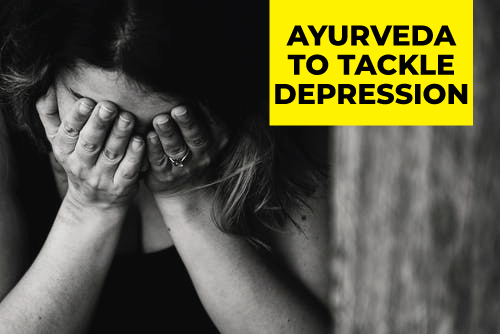
Our everyday lifestyle which is analogous to episodes of
undue stress and depression is making us vulnerable to ailments physically,
mentally and spiritually. Dr Sonica
Krishan, leading Ayurveda Consultant
and Holistic Healing Coach, writes on the topic ‘Ayurvedic treatments for
depression’.
According to Ayurveda, our body as well as mind is ruled over
by three doshas (Vata, Pitta and Kapha) or
the body humors viz. air, fire and phlegm. Vata
or the air, Pitta or the fire and Kapha or the phlegm when in a balanced
state reflects our natural wellness. But, vitiation in any of the three doshas results in ailments. And stress
(physical and mental) tends to straightaway interfere with the natural balance
of the three humors or doshas, as a
consequence of which the body loses its natural wellness, resulting in depression.
Ayurveda believes the main causative factor in mental disease
to be the increase/ imbalance in the mental states of brain i.e. ‘Rajas’ and ‘Tamas’. The two states, ascribed to ‘Iccha ‘(desire) and ‘Dwesh’
(repulsion), are predominantly triggered by stress. These, upon crossing the
limits set by social norms and values, excite the ‘doshas’ or basic humors of the body resulting in degeneration of
the brain powers and causing mental
diseases.
• Vitiation in Vata
dosha destroys mental sense and gives rise to grief and infatuation.
• When the fire or ‘Pitta’
manifests and increases inside the body, we experience excessive fear, lust and
grief.
• Imbalance in Kapha
dosha causes lethargy, anxiety and in-discrimination.
Ayurveda believes in removing or staying away from the causes
of depression along with change in thought process, counselling, correcting the
imbalanced doshas and strengthening the
ojas. The treatment modalities for
depression include panchakarma,
external therapies, internal medications, activities, proper diet and life
style changes.
Panchakarma – Vamana, Virechana, Basti , Nasya
External Therapies– shirodhara,
Shiro Basthi, Shiro pichu, Abhyanga
Internal Medications – Medhya rasayana – as Ashwagandha (Withania somnifera), Brahmi (Bacopa
monneri), Vacha (Acorus calamus), Shankhapushpi, jatamamsi (Nardostachys
jatamansi).
Ayurveda case studies for depression
Case Study 1: Kushmand
Ghrita in the Management of depressive Illness
Ayurveda uses Medhya
Rasayana drugs for treating depressive illness. Kushmanda Ghrita was taken as a trial drug to treat 35 patients
clinically diagnosed of depression, using the DSM-IV diagnostic criteria. The
patients were administered two doses of 10 ml Kushmanda Ghrita with 20 ml lukewarm water in morning & evening
for one month. The trials showed significant results with psychometric
parameters. There was significant reduction of depression symptoms i.e.
anxiety, sad mood, low confidence, suicidal tendencies, lack of interest. Also,
the candidates showed memory increase after treatment.
Study conducted at: AYU Govt. Ayurvedic College, Burhanpur,
Madhya Pradesh
Case Study 2: Brahmi
Ghrita and its effects on depression
Vishada and Avasada are the two conditions recognised as depression in
Ayurveda, and the herbal formulation of Brahmi
Ghrita, recognised as one of the ‘Medhya
rasayana drugs’ has been proved to be highly effective in controlling depression.
A trial was conducted on 42 patients clinically diagnosed of depression, using
the DSM-IV diagnostic criteria to analyse the psychoactive effect of Brahmi Ghrita on depression. 25 patients
were administered Brahmi Ghrita and
17 with placebo capsule. Brahmi Ghrita
showed moderate improvement on 40 per cent patients and mild improvement for
balance and was statistically highly significant (p<0.005) as compared to
placebo.
Study Conducted at: Gujarat Ayurveda University, Jamnagar
India.
Case Study 3: Efficacy
of Manasamrita Vataka on Generalized
Anxiety Disorder with Comorbid Generalized Social Phobia
Manasamitra Vataka has been used in this clinical trial
for treating 72 patients, in the age group of 20 and 55, diagnosed with
generalized anxiety disorder (GAD) with comorbid generalized social phobia
meeting DSM IV TR criteria. The trial was conducted in random 3 groups.
Group 1: 24 patients were given Manasamitra Vataka tablets, 100 mg, twice daily, for 30 days.
Group 2: 24 patients were given Manasamitra Vataka for 30 days & Shirodhara therapy (which involves dripping of medicated oil over
the forehead) for 7 days.
Group 3: 24 patients were given Clonazepam 0.75 mg daily in divided dose for 30 days.
Manasamitra Vataka has proven to be very effective and shown
showed significant reduction in clinical parameters. It resulted in reducing
severity of the disease and anxiety, mood stabilization for patients. For group
2 Shirodhara reduced the drowsiness
during daytime and showed an improvement in the quality of life of patients.
Study Conducted at: NIMHANS (Deemed University), Bangalore,
India
Case Study 4: Clinical Evaluation of (Withenia somnifera) Ashwagandha Kshirpaka and Shirodhara in the Management of depression
(Avsada)
A study was conducted on 30 (15 patients each, randomly
selected) clinically diagnosed depression patients to evaluate the
effectiveness of Ashwangandha kshirpaka
& Shirodhara.
Group A: Ashwanagandha
Kshirpaka– 5gms & milk to make kshirpaka,
2 times a day, 60 days
Group B: Ashwanagandha
Kshirpaka- 5gms & milk to make kshirpaka,
2 times a day, 60 days & Shirodhara
with Bala Tail for 7 days (conducted
twice in a gap of 3 weeks)
Both the groups showed positive response but Group B gave
more significant positive results. Shirodhara
therapy was found to be safe and effective, generating tranquilizing and
relaxation effect on patients resulting in mental & physical fitness after
the treatment.
Study Conducted at: J.A.M.C. Nagpur,
India.
(Dr Sonica Krishan, B.A.M.S.,
A.D.N.Y., Ayurveda Wellness Guide and Consultant, is an internationally
recognized Author and Speaker in the areas of “Healthy and Joyous Living
through Ayurveda, Yoga, Meditation and other Contemplative Practices”. She is
based at Chandigarh, India. She is a leading Ayurveda professional besides a
Health writer, Columnist and a Preventive Healthcare Coach. She has authored
five books on Ayurveda and Natural Health Care)







